

Emergent AI sits in the new wave of “vibe coding” tools that promise to turn plain-language ideas into working web and mobile apps. The appeal is obvious: describe the product, let the AI build the front end, back end, database, integrations, and deployment flow, then keep refining through chat. But the real question is not whether Emergent can build something. It can. The harder question is whether it can build something reliable, affordable, editable, and safe enough for real use.
The Quick Verdict
Emergent AI is best understood as an ambitious AI software-building workspace, not a simple no-code website maker. Its strongest value appears when a founder, product manager, solo builder, or small team wants to move from idea to working prototype quickly. It can generate full-stack apps, support web and mobile builds, host private projects on paid plans, connect with GitHub, and use advanced agent features on higher tiers. Its official positioning is clear: users describe what they want, and the AI handles coding, design, and deployment from the conversation layer.
The platform’s weak side is just as important. User feedback is sharply mixed. Some users say the platform helps them build faster, while others report credit burn, slow support, AI loops, instability, billing issues, and trouble exporting projects. Public reviews reflect this split: TrustScore is 3/5 from 397 reviews, with many 1-star ratings, while smaller review pages are more positive but based on very limited samples.
| Review Signal | Current Snapshot | What It Means |
| Trustpilot | 3/5 from 397 reviews | Highly polarized feedback, not a clean trust signal |
| 5-star share | 38% | A sizable group finds real value |
| 1-star share | 49% | Serious dissatisfaction cannot be ignored |
| Software review listing | 5.0/5 from 3 reviews | Too limited for strong conclusions |
| Reddit sentiment | Mixed | Powerful for prototypes, risky for cost and support-sensitive projects |
What Emergent AI Actually Does
Emergent AI is built around a simple interaction model: users describe the app they want, and the platform’s AI agents attempt to plan, code, test, and deploy it. That makes it different from traditional no-code tools where users manually assemble screens, databases, workflows, and permissions. Emergent compresses that process into a chat-led build cycle.
Emergent targets users who want working software without coding from scratch, including founders, product managers, agencies, and non-technical operators. Its official positioning is a platform for building production-ready apps through conversation, with agents handling design, code, and deployment.
That means it should not be judged like a basic landing-page generator. Emergent is aiming to act more like a browser-based junior engineering team that can scaffold the front end, create the back end, work with databases, build app logic, and deploy the result. The promise is strong, but the risk is higher because users depend on its accuracy, memory, debugging, and support.
Feature Coverage: Where the Platform Looks Strong
Emergent’s core strength is breadth. It is not just a prompt-to-page generator. Paid plans mention web and mobile app building, private project hosting, GitHub integration, fork tasks, a 1 million context window, ultra thinking, system prompt editing, custom AI agents, high-performance computing, and priority support on the Pro tier. The free plan includes 10 monthly credits, while the Standard annual plan is shown at $20 per month with 100 credits, and the Pro annual plan is shown at $200 per month with 750 credits.
For a builder, the practical advantage is speed. Instead of spending days creating the same starting structure for every app, Emergent can generate the first working version quickly. That can be useful for:
● MVPs that need to be shown to investors, clients, or early users
● Internal tools where speed matters more than visual uniqueness
● Product experiments that may be discarded if validation fails
● CRUD apps, dashboards, forms, admin panels, and lightweight marketplaces
● Early versions of mobile or web apps where the workflow is still being discovered
The strongest user stories usually come from people who know what they want to build but do not want to manually assemble the first version. One Reddit user described the platform as approachable, especially for people familiar with Bubble or Webflow, but also noted that users still need basic workflow logic to get the most from it.
| Area | Emergent AI’s Apparent Strength | Critical Reading |
| Prompt-to-app building | Fast first draft generation | Best for clear requirements, not vague ideas |
| Full-stack scope | Can work across front end, back end, and database | More moving parts means more failure points |
| Mobile and web support | Useful for founders testing app concepts | Production polish still needs review |
| Long context on Pro | Better memory for complex requirements | Expensive if credits burn quickly |
| GitHub integration | Helps with code ownership workflow | Users still need technical confidence |
| Hosting and deployment | Reduces setup friction | Migration complaints make exit planning important |
The Experience: Fast When It Works, Costly When It Wanders
The most important part of Emergent AI is not the feature list. It is the iteration loop. You prompt the platform, inspect what it builds, ask for fixes, refine screens, adjust logic, add integrations, debug errors, and publish. That loop can feel magical when the agent understands the request and makes the right changes. It can also become expensive and frustrating when the AI misreads the task, gets stuck in loops, or burns credits while trying to fix its own mistakes.
This is the core tension in Emergent’s user experience. Traditional no-code tools are slower, but their behavior is more visible. AI builders are faster, but they can hide complexity behind conversation. If the agent makes the wrong architectural choice early, non-technical users may not notice until later. If the app breaks, they may not know whether the issue is in the database, API, front end, deployment settings, authentication, or generated logic.
That is why Emergent works best for users who can describe requirements clearly and test outputs aggressively. It is less suitable for users who expect to type one prompt, receive a polished commercial app, and never inspect what was generated.
Pricing and Credit Economics
Emergent’s pricing combines a subscription with usage-based pressure. Its plans include a free tier with 10 monthly credits, Standard at $20 per month annually with 100 credits, and Pro at $200 per month annually with 750 credits plus advanced features like larger context, advanced thinking, custom agents, and priority support.
The main concern is the credit model. While $20 per month may seem affordable, real costs can rise quickly if users need repeated iterations, debugging, redesigns, or migration help. Many complaints focus on fast credit usage, unclear deductions, and credits being spent during troubleshooting rather than productive app building.
| Plan | Listed Price | Credits | Best Fit | Watchout |
| Free | $0/month | 10 monthly credits | Testing interface and basic capability | Too limited for serious builds |
| Standard | $20/month, annual display | 100 monthly credits | First MVPs, simple web or mobile apps | Credit burn can matter quickly |
| Pro | $200/month, annual display | 750 monthly credits | Serious builders, agencies, complex prototypes | Cost only makes sense with disciplined usage |
| Enterprise | Custom | Custom | Larger teams | Needs contract-level clarity |
The real question is not “Is Emergent cheap?” It is “How many usable app changes do I get per dollar?” That answer depends heavily on prompt quality, app complexity, debugging needs, and whether the user can solve some issues outside Emergent.
Real User Review Pattern: The Split Is the Story
The review picture is unusually polarized. Positive users praise speed, app generation, ease of use, and the ability to build things they otherwise could not ship. Negative users focus less on whether the AI can build and more on whether the platform is dependable once money, support, credits, and project continuity become important.
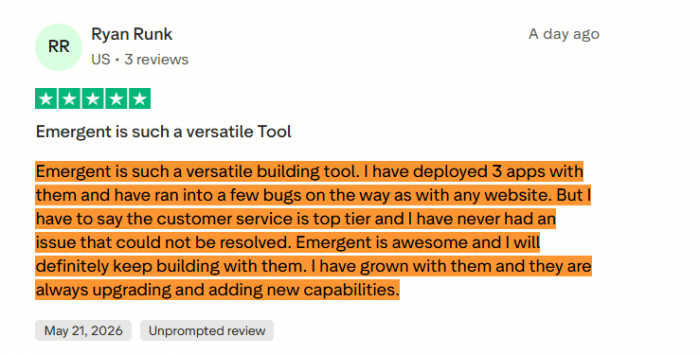
On the positive side, users describe Emergent as powerful for generating working apps, handling complex builds, and helping non-technical users move faster. One public review mentions deploying three apps and seeing the platform improve over time.
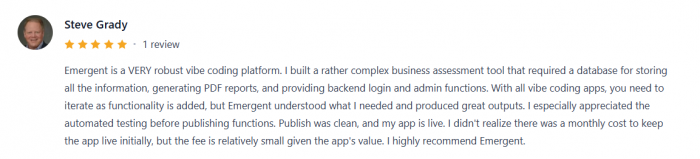
A product-launch review summary says users commonly praise fast full-stack app creation, intuitive interface, clean code, strong output on complex projects, and useful testing and publishing flow.
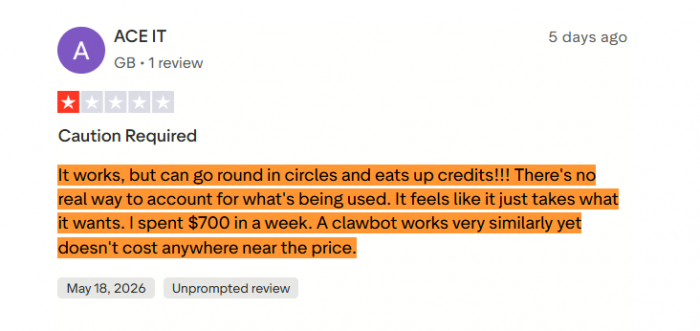
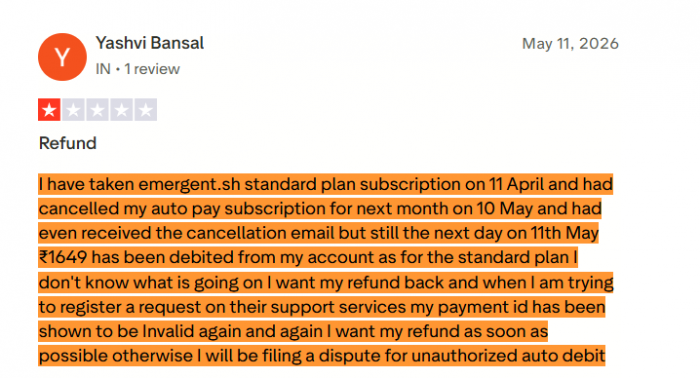
On the negative side, the same review ecosystem shows heavy dissatisfaction. The large public review profile currently has 49 percent 1-star reviews, which is too high to dismiss as normal software noise. Recent negative themes include support problems, billing concerns, AI agents getting stuck, credit usage frustration, app instability, and difficulty resolving account or refund issues.
| What Users Like | What Users Complain About |
| Fast app generation | Credits can disappear quickly |
| Good for prototypes and MVPs | Debugging can become expensive |
| Useful for non-coders | Support experience appears inconsistent |
| Can handle full-stack workflows | AI can loop or miss requirements |
| Mobile and web build support | Migration and ownership can be stressful |
| Strong first-draft productivity | Not always production-ready without review |
Reddit Sentiment: Powerful, but Not a Shortcut Around Technical Judgment
Reddit feedback is useful because it often captures practical friction that polished review pages miss. The pattern there is not simply positive or negative. It is conditional.
One Reddit discussion framed Emergent as useful for getting roughly “70 percent” of the way faster, but warned that the final custom portion is where non-coders may struggle. That is a fair reading of the category. AI app builders are excellent at scaffolding common patterns, but unique product behavior, edge cases, security, scaling, and deep customization still require judgment.
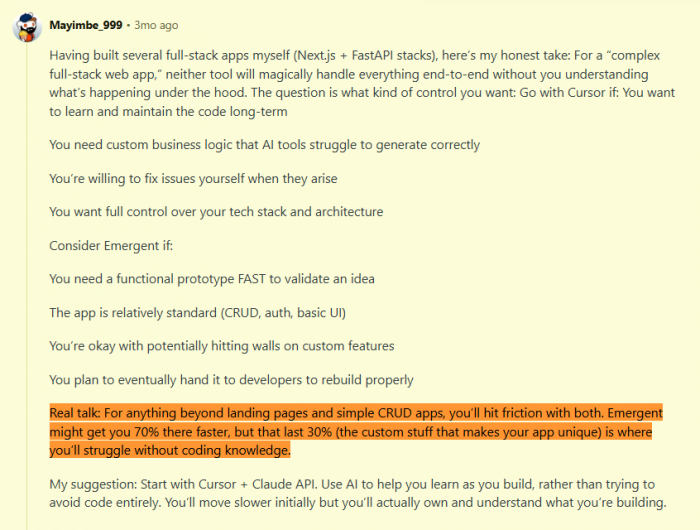
Another Reddit user called the experience expensive and unstable, citing fast credit burn and the agent sleeping during development. A separate user said building and deployment were “ok,” but migration to external hosting became painful, and support felt absent while questions consumed credits. reddit
The more positive Reddit comments point to approachability and long-context benefits. One user liked the 1 million context window because it helped the agent remember long instructions and architectural details. Another said the learning curve was manageable for people familiar with no-code tools, though basic logic remained necessary. reddit2
The consolidated Reddit verdict is this: Emergent is not a magic replacement for product thinking. It is a fast build assistant that becomes more valuable when the user can define requirements, test carefully, and understand enough logic to catch bad decisions.
Quality of Output: Prototype Strong, Production Needs Discipline
Emergent’s biggest promise is “production-ready” app generation. That phrase should be handled carefully. A generated app can be deployable without being business-ready. A production-ready product needs stable logic, secure authentication, clean error handling, maintainable code, predictable database behavior, responsive UI, payment safety if relevant, and a plan for future changes.
Emergent can help reach a working version quickly, especially for common app structures. But real production use should involve a review step. For anything involving payments, private user data, healthcare, financial information, marketplace transactions, or customer accounts, generated code should be audited before launch.
A practical way to judge Emergent output is to separate “visible completeness” from “operational completeness.”
| Layer | What Looks Complete Quickly | What Still Needs Review |
| UI | Screens, forms, dashboards, navigation | Accessibility, consistency, brand polish |
| Logic | Basic workflows and CRUD actions | Edge cases, failed states, permissions |
| Database | Tables, records, simple relationships | Data integrity, backups, scaling |
| Integrations | API connection attempts | Error handling, security, rate limits |
| Deployment | App can go live | Monitoring, rollback, portability |
| Code | Working generated structure | Maintainability and future editing |
Trust, Support and Ownership
The trust evaluation is where Emergent becomes complicated. On the platform side, the website presents serious trust signals, including SOC 2 Type I language, product documentation, pricing pages, terms, privacy policy, and support resources.
But trust is not only about security badges. For an AI app builder, trust also means:
● Can users clearly understand what credits are used for?
● Can they export or move their project without friction?
● Does support respond when billing or deployment goes wrong?
● Does the AI preserve work safely?
● Are failed agent loops charged fairly?
● Can non-technical users understand what they own?
User feedback suggests these are the areas Emergent needs to handle better. The strongest complaints are not about the concept. They are about operational confidence: support responsiveness, billing clarity, credit transparency, app stability, and migration. That matters because the platform is not selling a lightweight content tool. It is selling a place where users may build core business software.
![Suggested image: A trust evaluation graphic with app ownership, billing clarity, support response, code export, and security checklist. Minimal editorial style.]
Who Should Use Emergent AI?
Emergent AI makes the most sense for users who value speed and can tolerate iteration risk. It is especially useful when the goal is to validate a concept before hiring developers or committing to a full engineering roadmap.
| User Type | Fit | Reason |
| Solo founder | Strong fit | Can build MVPs quickly before spending on development |
| Product manager | Strong fit | Useful for turning specs into interactive prototypes |
| Agency | Conditional fit | Good for drafts, risky if client expects polished production output |
| Non-technical small business owner | Conditional fit | Helpful, but support and ownership questions matter |
| Developer | Good assistant | Can accelerate scaffolding, but manual review remains essential |
| Enterprise team | Case-by-case | Needs governance, security review, and contract clarity |
| Complete beginner with no testing process | Risky | May not know when generated logic is wrong |
Where Emergent AI Falls Short
The biggest limitation is not that Emergent fails to build. It is that the user may not always know what has been built, what it will cost to fix, or how durable the output is. This is the central risk of AI-led development platforms.
A second limitation is design control. Some hands-on reviews note that Emergent is more impressive for app logic than visual originality, with UI sometimes feeling generic or templated. That is not fatal for internal tools or early MVPs, but it matters for consumer apps, landing pages, marketplaces, and products where visual trust affects conversion.
A third limitation is support dependency. If a user is non-technical and the app breaks, support quality becomes part of the product. Public complaints about slow or inconsistent support therefore carry more weight here than they would for a simple AI writing tool.
Best Use Cases
Emergent AI is most useful when the app idea is specific, the data model is not too unusual, and the user is willing to test each stage.
Good use cases include:
● Booking systems
● Internal dashboards
● Basic marketplaces
● Form-based apps
● Admin panels
● MVPs for SaaS ideas
● Mobile prototypes
● Lightweight CRM-style tools
● Portfolio or directory apps
● Product validation demos
Poorer use cases include highly regulated apps, security-heavy products, complex consumer social platforms, advanced video editors, large-scale fintech workflows, or projects where ownership and long-term maintainability matter from day one.
Personal Rating: 3.4/5
Emergent AI scores well for speed, ease of use, and early app generation. It is useful for MVPs, internal tools, demos, and structured app ideas where the user can test each workflow carefully.
The score comes down because the platform still has trust and reliability concerns. Credit usage, support complaints, AI loops, export friction, and mixed public reviews make it harder to recommend for serious production use without technical review.
| Category | Rating |
|---|---|
| Ease of Use | 4.0/5 |
| App-Building Speed | 4.2/5 |
| Output Reliability | 3.2/5 |
| Pricing Value | 3.0/5 |
| Support and Trust | 2.8/5 |
| Overall Rating | 3.4/5 |
Emergent AI is worth testing for fast prototypes, but it should not be treated as a fully dependable production platform yet.
Final Verdict
Emergent AI is one of the more ambitious tools in the AI app-builder category. Its appeal is real: it can compress the early software-building process and help non-technical users get from idea to working product faster than traditional no-code platforms. For MVPs, demos, internal tools, and structured app ideas, that is valuable.
But it should not be treated as a frictionless replacement for software development. The public review picture is too polarized for that. The current large-review-site rating of 3 out of 5 from 397 reviews, combined with nearly half of reviewers giving 1-star feedback, signals serious user frustration around reliability, support, credits, and billing. At the same time, positive ratings on smaller review surfaces show that the product can deliver strong results for users whose projects fit the platform well.
The smart way to use Emergent is not to bet your whole product on it immediately. Start with a contained prototype, define requirements clearly, track credit usage, test every workflow, connect GitHub early, document what the AI changes, and avoid putting sensitive or payment-heavy systems into production without technical review.
Emergent AI is powerful, but power is not the same as predictability. It can help users build faster. It still requires judgment to build safely.
Comments