

A Reel can have a useful idea, sharp editing, and a strong payoff and still lose viewers before any of that matters. The opening line has to give someone a reason to stay long enough to discover what the video is actually about.
AI hook generators are useful because they remove some of the blank-page work. The better ones do more than add dramatic words to an ordinary sentence. They help creators approach the same idea through curiosity, contrast, a question, a specific problem, or an unexpected observation. The seven tools below take noticeably different approaches to that job.
Best AI Hook Generators at a Glance
| Tool | Best for | Free option | Paid plans start at |
| Jupitrr AI | Hooks that continue into a video workflow | Yes | $18/mo annually |
| SmartPostly Hook Generator | Fast social media hook ideas | Yes | $9/mo |
| Submagic | Platform-specific short-video hooks | Yes | $12/mo annually |
| Sandcastles | Research-backed hook ideas | Trial | $39/mo annually |
| Copy.ai | Hooks alongside broader marketing copy | Free hook tool | $24/mo annually |
| Easy-Peasy.AI | Affordable multi-template writing | Yes | $8/mo annually |
| Predis.ai | Hooks that continue into finished Reels | Trial | $24/mo annually |
Prices can change, and annual plans usually differ from month-to-month billing. The individual sections below explain what is included and where each tool makes the most sense.
1. Jupitrr AI : Best for Hooks That Continue Into the Video
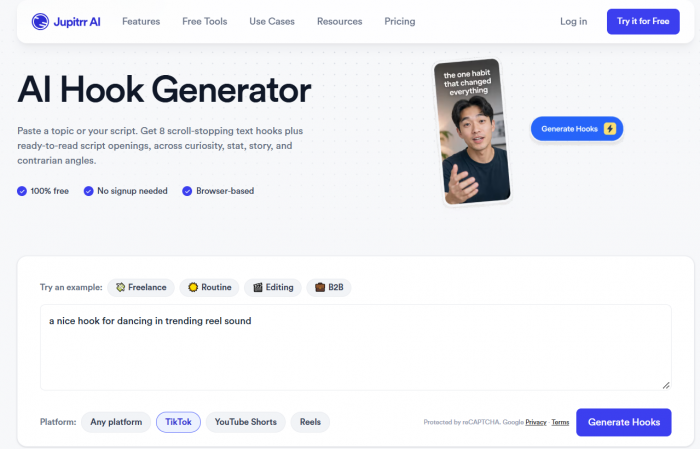
Jupitrr AI is more useful when the hook is only the beginning of the job. Its hook generator can work from either a topic or a fuller script and is designed around spoken video rather than generic marketing headlines. It can generate different opening angles, including curiosity-led, statistical, story-based, and contrarian approaches.
The bigger difference is what happens after the opening line. Jupitrr also connects scripting, recording, editing, content research, and publishing features. A creator can therefore start with a hook, continue the idea into a script, record it, and move into the video-editing process without treating the hook generator as an isolated tool. Its free hook generator is available without requiring a paid video plan.
Why it works
● It can accept more context than a one-line topic, which is useful when the hook needs to fit an existing script rather than invent an unrelated angle.
● Different hook approaches encourage creators to compare framing ideas instead of simply choosing between several rewrites of the same sentence.
● The wider workflow is particularly useful for talking-head videos where the hook, spoken script, recording, and edit need to feel connected.
Where it falls short: Jupitrr is more specialized around creators who actually record video. Someone who only wants occasional caption or text hooks may find much of the broader platform unnecessary.
Pricing: Jupitrr has a free plan with three video briefs and three uploads per month. Starter is $18/month when billed annually or $22 month to month. Pro is $39/month annually and adds features such as the AI scriptwriter, content calendar, viral video research, publishing, and analytics.
Best fit: Creators, consultants, founders, and coaches who want the hook to lead naturally into scripting and producing the finished video.
2. SmartPostly Hook Generator : Best for Fast Social Media Hook Ideas
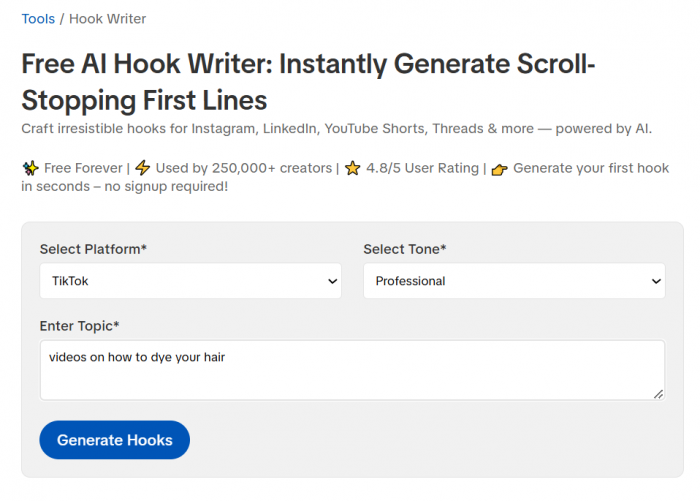
SmartPostly Hook Generator takes a simpler route. It is aimed at creators who already know roughly what their Reel or TikTok will cover but need a stronger way to start it. Instead of building a detailed prompt or moving through a large video-production interface, the focus is on quickly producing social-content ideas that can be edited into a usable opening.
That simplicity is useful when hooks are part of a much larger weekly content workload. SmartPostly also groups the hook tool with generators for captions, scripts, bios, ideas, and other social copy. A creator who needs several pieces of supporting content around the same post therefore does not have to treat hook writing as a completely separate workflow. All of its plans include access to the SmartPostly tool collection.
Why it works
● The interface is built around social content, which makes it easier to move quickly from a rough idea to possible opening lines.
● It suits creators who want useful variations without having to write long instructions before every generation.
● Access to other social tools makes it practical when a hook also needs to become a caption, script, bio, or supporting post.
Where it falls short: Simplicity also means the generated line should not automatically be treated as the finished hook. Broad topics can still lead to broad outputs, so adding a concrete problem, result, or audience detail usually produces a stronger final line.
Pricing: The Starter plan is free and includes 50 total requests. Creator costs $9/month for 500 requests, while Professional is $16/month for 5,000 requests. Enterprise and API users can request flexible pricing.
Best fit: Creators, freelancers, and social media managers who need hooks regularly and prefer a quick social-focused workflow over a large AI writing platform.
3. Submagic : Best for Platform-Specific Short-Video Hooks
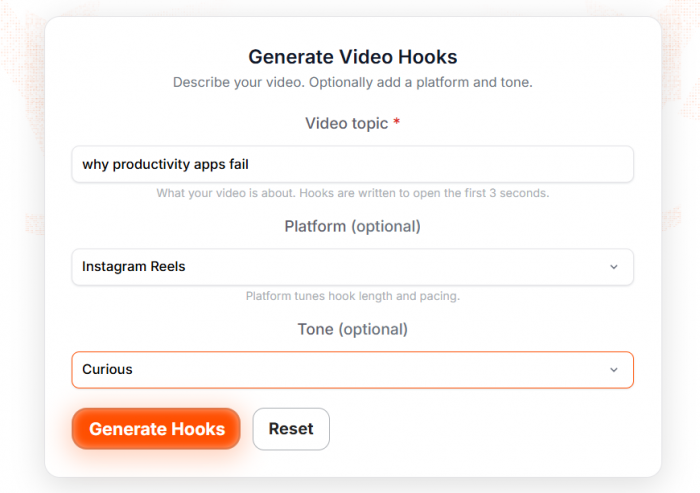
Submagic's free Video Hook Generator is unusually focused on the actual opening seconds of a video. Users describe the video, optionally select a platform and tone, and receive five opening lines designed to work within roughly the first three seconds.
The platform option matters. A TikTok opener does not always need the same pacing as a longer YouTube introduction, and Submagic can adjust its output for TikTok, Instagram Reels, Shorts, or longer video. The tool also intentionally varies the approach, including questions, bold claims, curiosity gaps, and other hook structures rather than returning five nearly identical sentences. The generator itself is free and does not require signup.
Why it works
● Five different approaches make it easy to shortlist two hooks and compare which one better matches the actual video.
● Platform and tone controls provide more context than a basic “enter your topic” generator.
● The hook generator sits beside Submagic's video scripting and editing tools, so creators can continue working on the same content after choosing the opener.
Where it falls short: The free hook generator is excellent for ideation, but many of Submagic's more valuable production features belong to the paid video editor. Paying for the complete platform solely to generate hooks would be unnecessary.
Pricing: The hook generator itself is free with no signup. For the full editing platform, Starter costs $19/month or $12/month when billed yearly. Pro is $39 monthly or $23 on annual billing, while Business costs $69 monthly or $41 annually.
Best fit: Reel and TikTok creators who want short spoken hooks and appreciate being able to control the intended platform and tone.
4. Sandcastles : Best for Research-Backed Hook Ideas
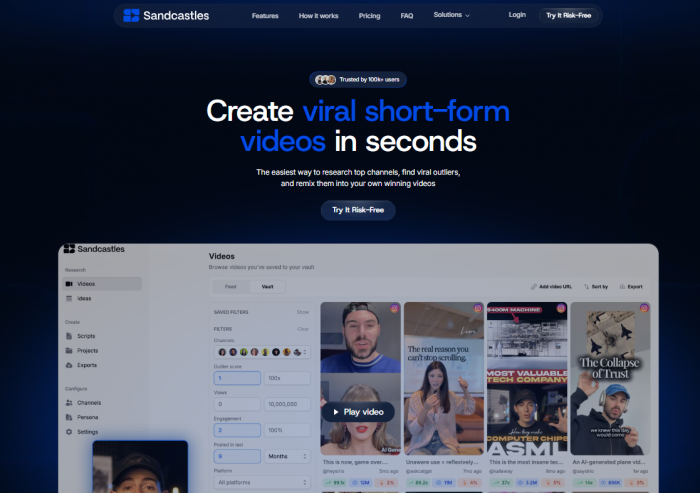
Sandcastles approaches hook generation from a different direction. Instead of beginning only with whatever the creator types into a prompt box, the platform is built around finding high-performing short-form videos in a niche and studying what made them work.
Creators can track competitors, identify videos that performed unusually well relative to a channel's normal results, examine transcripts, and use those patterns as material for new hooks and scripts. That makes Sandcastles more interesting for creators who are tired of generic formulas such as “You won't believe this” or “Three things nobody tells you.” The starting point is actual content research rather than a blank prompt.
Why it works
● Research into outlier videos can reveal hook structures already appearing in a creator's own niche.
● The tool connects hook ideation with competitor research and script creation rather than treating each as a separate task.
● It is useful for spotting patterns across TikTok, Instagram Reels, and YouTube Shorts before writing the next video.
Where it falls short: Sandcastles are considerably more expensive than a simple hook generator. Its value comes from the research and strategy tools around the hook, so it is harder to justify for someone who only needs a handful of opening lines each month.
Pricing: Sandcastles Pro costs $49/month or $39/month when billed annually and includes 100 monthly credits. Visionary costs $99 monthly or $79 annually, while the higher-volume Titan plan costs $499 monthly or $399 annually.
Best fit: Serious short-form creators and teams that want to base hook ideas on competitor and niche research instead of generating lines in isolation.
5. Copy.ai : Best for Hooks Alongside Broader Marketing Copy
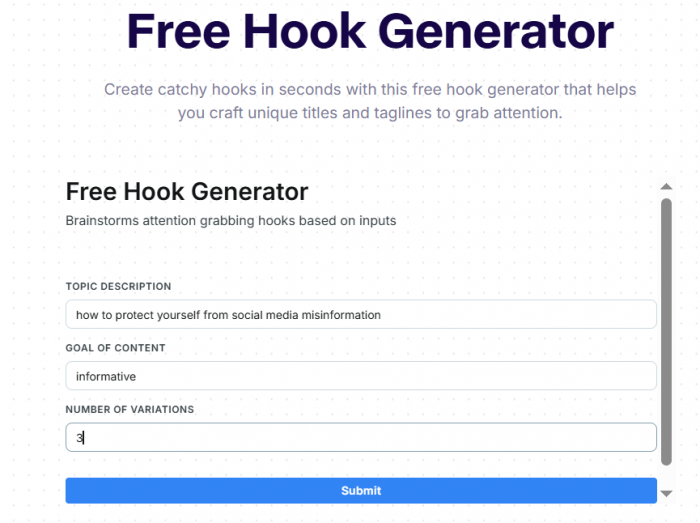
Copy.ai has a dedicated free AI Hook Generator, but its scope is broader than TikTok or Reels. The tool can take a topic, idea, or message and create possible openings for social posts, ads, articles, emails, and other marketing material.
That broader focus is both its strength and its limitation. Copy.ai can be useful when the same campaign needs a short-video hook, an ad angle, an email opener, and other supporting copy. It also allows additional context such as an audience or desired tone to shape the output. However, its hook generator is not as specifically designed around spoken short-form video as Submagic or Jupitrr.
Why it works
● It can create multiple hook directions from a simple core topic while allowing additional audience and tone context.
● The broader Copy.ai platform is useful when a hook forms part of a larger marketing campaign rather than a standalone Reel.
● Its dedicated hook generator provides a much faster entry point than creating a complete workflow inside the main platform.
Where it falls short: Because Copy.ai serves many marketing use cases, some generated hooks can read more like headlines, ad copy, or written social posts than something a person would naturally say at the start of a TikTok. Reading the result aloud before using it is especially important.
Pricing: Copy.ai provides a free Hook Generator. Its full Chat plan costs $29/month on monthly billing or $24/month when billed annually and includes five seats with unlimited words in Chat. Higher workflow-based plans start at $1,000 per month.
Best fit: Marketers and small teams that need hooks as one part of a wider content and campaign-writing workflow.
6. Easy-Peasy.AI : Best for Affordable Multi-Template Writing
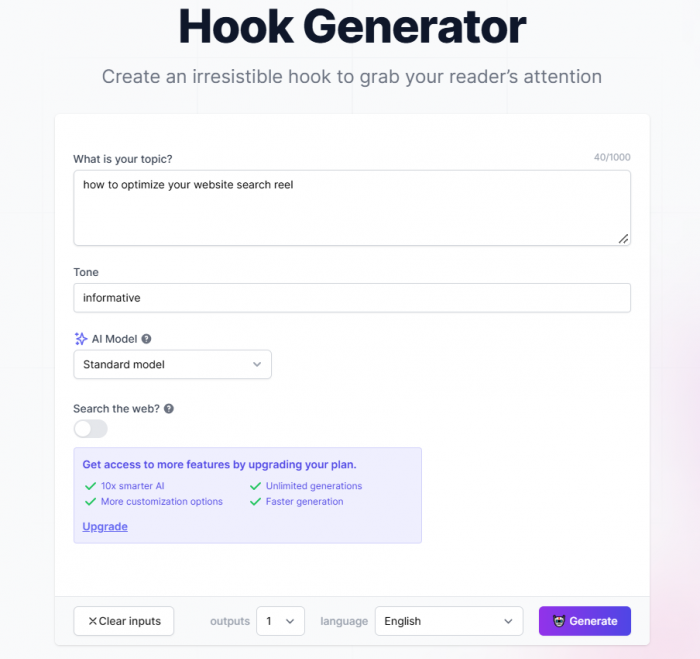
Easy-Peasy.AI works less like a dedicated short-video platform and more like a large AI writing toolbox. Its appeal is the range: the service combines hundreds of writing templates with AI chat, brand voices, image and video generation credits, transcription, and other creative tools.
For hook creation, that means creators have more room to move between different content jobs without buying several narrowly focused subscriptions. It can be particularly useful for someone who needs opening ideas for Reels one day and captions, ad copy, or longer written content the next. The free plan also gives users a practical way to judge the output before paying.
Why it works
● A broad template library gives creators more options beyond hook writing without requiring a high starting price.
● Paid plans add brand voices, which can help when generated hooks need to stay closer to a recognizable content style.
● It supports dozens of languages, making it more flexible for creators producing content for different audiences.
Where it falls short: Breadth does not automatically create better short-form hooks. Because Easy-Peasy.AI handles many kinds of writing, users may need to give clearer instructions about platform, speaking style, audience, and video payoff to prevent generic output.
Pricing: A free plan includes 1,000 words and access to more than 170 templates. Starter costs $8/month when billed annually, Unlimited 50 costs $12, and Unlimited costs $16.50 per month on annual billing.
Best fit: Budget-conscious creators who want hook generation alongside a larger collection of general AI writing and content tools.
7. Predis.ai : Best for Turning Hook Ideas Into Finished Reels
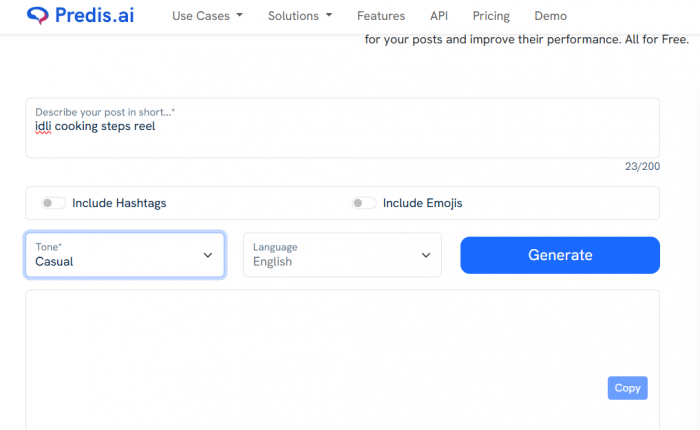
Predis.ai is a stronger fit for creators who want the hook to become part of the finished Reel or TikTok rather than stopping at text generation. A user can start with a short idea, product URL, or simple prompt, and the platform writes the opening hook and supporting script before building the rest of the video with visuals, captions, and voiceover.
That makes it different from a standalone hook generator. The opening line is created in the same workflow as the scenes that follow, which can reduce one common problem with AI hooks: generating a dramatic opener that does not naturally connect with the rest of the video. Predis.ai also supports Reels, TikToks, YouTube Shorts, product videos, educational content, and faceless formats.
Why it works
● It writes the hook and supporting video copy together, making it easier to maintain a clear connection between the opening promise and the rest of the content.
● Creators can move directly from the idea into visuals, voiceover, captions, and editing instead of transferring the hook into a separate production tool.
● It is particularly useful for creators producing multiple short videos because the same platform can generate, edit, schedule, and publish social content.
Where it falls short: Predis.ai is much larger than a simple hook-writing tool. Someone who only wants ten opening lines for an already-recorded Reel may find the full video workflow unnecessary, especially compared with lightweight generators.
Pricing: Predis.ai currently offers a trial before upgrading. The Core plan costs $24/month when billed annually and includes 1,300 monthly credits. Rise costs $55/month annually with 3,200 credits, while Enterprise+ costs $212/month annually with 10,000 credits.
Best fit: Creators, small businesses, and social teams that want AI to handle more than the opening sentence and help turn a rough Reel or TikTok concept into a finished piece of content.
How to Choose the Right AI Hook Generator
The best choice depends less on how many hooks a tool can produce and more on what happens before and after generation.
For creators who simply need quick ideas several times a week, SmartPostly keeps the process light. Submagic makes more sense when the main concern is creating spoken short-form openers with platform and tone controls. Jupitrr becomes more useful when the hook needs to continue into a script, recording, and finished video.
Creators who prefer research before writing may get more from Sandcastles, while Copy.ai and Easy-Peasy.AI are stronger fits when hook writing is only one of several marketing or writing tasks. Predis.ai makes more sense when the creator wants to move directly from the opening hook into scriptwriting, visuals, editing, and publishing.
Whatever tool is used, the final check should remain human. A hook needs to sound natural when spoken and accurately describe what the viewer will receive next. A dramatic first line that creates curiosity but leads into an unrelated video has solved the wrong problem.
Final Perspective
AI hook generators are most useful as angle generators, not automatic replacements for good judgment. Their real value is showing several possible ways into the same idea: a question, a surprising detail, a contradiction, a specific pain point, or a story opening that might not have occurred immediately.
Jupitrr offers the most connected creator-focused scripting workflow, while SmartPostly provides a much lighter option for creators who mainly want fast social content ideas. Submagic is particularly practical for short-form spoken hooks, while Sandcastles, Copy.ai, and Easy-Peasy.AI suit creators who need research or broader writing support. Predis.ai stands out when the goal is to take a hook beyond text and turn the same idea into a finished Reel or TikTok.
Whichever one fits the workflow, the best generated hook is rarely the loudest sentence on the screen. It is the one that makes a clear promise, sounds believable coming from the creator, and gives the rest of the Reel or TikTok something worth paying off.
Comments