

I've written enough captions to recognize the exact moment things stall: the photo's edited, the post is half-formed in your head, and then the little box underneath just sits there blinking at you. SmartPostly and Predis.ai both promise to fill that box. But they go about it so differently that "which is better for captions" doesn't have a lazy answer; it depends on what you're actually walking in with. Here's what I found when I stopped comparing feature lists and started comparing the captions themselves.
First, what makes a caption actually good?
If you don't define this up front, any comparison turns into vibes. So before naming a winner, here's the yardstick I'm holding both tools against and you can reweight it for your own priorities:
● Hook strength. The first line either earns the second line or it doesn't. On Reels and TikTok especially, a weak opener means the caption is never read at all, no matter how good the rest is.
● Brand voice consistency. A caption that's clever but sounds nothing like you is a caption you'll rewrite. The real test isn't "is this good writing," it's "could this have come from my account without anyone noticing?"
● Platform awareness. A LinkedIn caption and a TikTok caption are different species. A tool that hands you the same paragraph for both is doing half the job.
● Hashtags and CTAs. Relevant tags and a call-to-action that fits the post not five recycled #love #instagood fillers stapled to the end.
● Editing burden. This is the one nobody measures and everybody feels. If you spend eight minutes fixing a "30-second" caption, the tool didn't save you time, it just moved the work around.
Keep that last point in mind. It ends up being the deciding factor. Those criteria matter beyond a two-tool comparison. The wider range of AI caption generators for social media varies quite a bit in how it handles tone, platform-specific writing, hashtags, and editing control, so the best fit often comes down to which part of the caption workflow you actually want AI to handle.
Two tools doing genuinely different jobs
Here's the thing most comparisons miss because they line the two up as if they're the same kind of product. They're not.
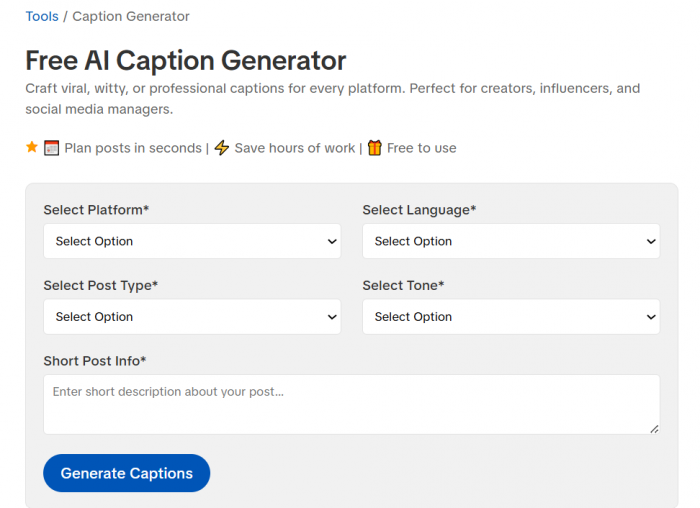
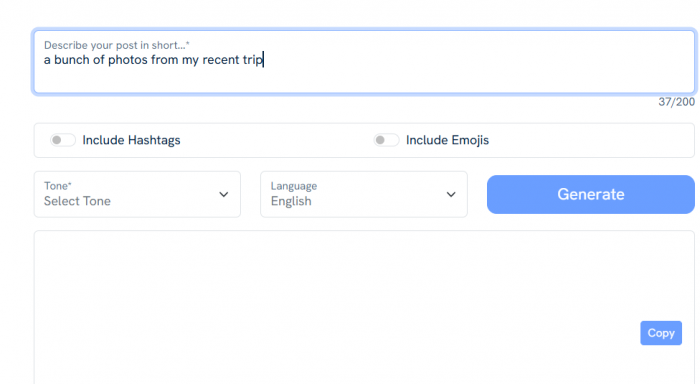
SmartPostly Caption Generator is a caption writer. You come to it with a photo or a video already in hand, tell it your topic, tone, and platform, and it hands you text. Captions, hooks, bios, hashtags, taglines, reel scripts it's a suite of fast, focused text tools. It doesn't make your visual. It assumes you've got that covered and its whole job is the words.
Predis.ai is a post factory. You give it a one-line idea and it builds the entire post the image or video, the caption, and the hashtags as a single package. The caption isn't written in a vacuum; the AI looks at the visual it just generated and writes copy that references what's actually in the frame. The caption is one output of a much bigger machine.
That distinction changes everything downstream, so it's worth sitting with. One tool writes words for content you already have. The other writes words as part of content it creates for you. Neither is wrong. But if you're evaluating them purely on captions, you're judging a specialist against a generalist and specialists and generalists fail in very different ways.
| Metric | SmartPostly | Predis.ai |
| Core job | Text generation (captions, hooks, bios, hashtags) | Full post generation (visual + caption + hashtags) |
| You bring | Your own image or video | Just an idea, or your own image |
| Caption is | The main event | One part of a bundled post |
| Free tier | Yes (~50 generations/month) | Yes (~15 posts/month) |
| Paid entry | ~$9–$35/mo, metered by "requests" | ~$32/mo, up to ~$249/mo for agencies |
| Languages | English | 19+ |
| Scheduling / publishing | Content calendar planning | Built-in multi-platform scheduling |
The head-to-head, criterion by criterion
Hook and first line
SmartPostly is built around this. It has a dedicated hook tool separate from the caption tool, and it shows the openers tend to be punchy, scroll-stopping, and short-form-native. If your content lives on Reels and TikTok where the first six words decide everything, this is a real strength.
Predis writes a competent hook, but because it's describing a visual it generated, the opener often leans descriptive and scene-setting rather than provocative. That's lovely for a considered Instagram carousel and a little slow for a fast-twitch TikTok. It rarely writes a bad first line; it just doesn't obsess over the hook the way a short-form creator does.
Brand voice and tone
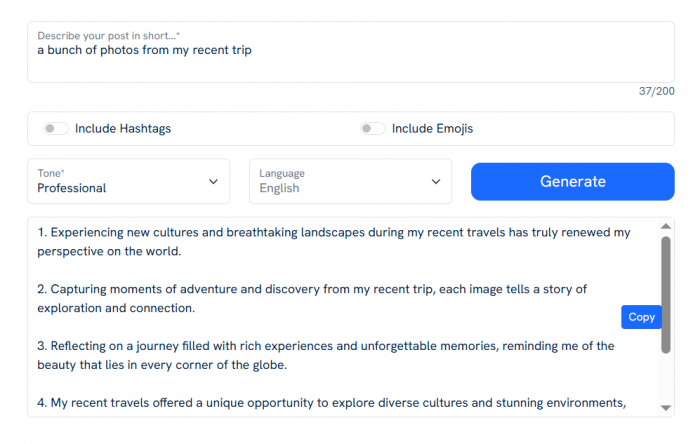
Predis has the structural advantage here. It supports a brand kit your colors, fonts, and a defined tone of voice and adapts captions to it across posts. When it's dialed in, the output feels consistent from post to post, which matters more than any single caption sounding perfect.
SmartPostly asks for your tone per generation rather than storing a persistent brand voice, so consistency depends on you feeding it the same instructions each time. It's flexible and fast, but the voice lives in your head, not the tool. For a solo creator that's fine. For a team trying to keep three people on-brand, it's friction.
Platform adaptation
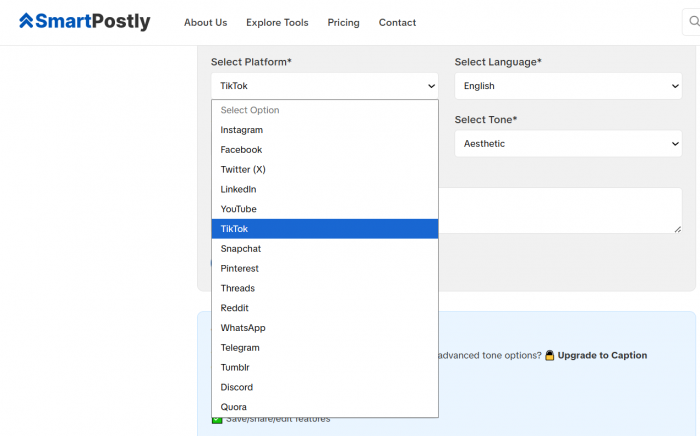
Both claim per-platform output, and both genuinely do adjust length and register for Instagram, LinkedIn, TikTok, and Twitter/X. The difference is depth. Predis reformats the whole post per channel as part of publishing, so the adaptation is baked into the workflow. SmartPostly adapts the text when you tell it the platform, which is quicker but more manual.
Hashtags and CTAs
Roughly even, with a slight edge to Predis for bundling relevant hashtags automatically alongside the caption and visual, tuned to the post's actual subject. SmartPostly has a separate hashtag finder that's fast and solid, but it's a second step rather than part of one output. If you like your hashtags handed over in the same breath as the caption, Predis wins on convenience. If you prefer picking tags yourself from a fresh list, SmartPostly's dedicated tool is arguably better for that.
Editing burden the quiet decider
This is where the honest cracks show, and both tools have one.
SmartPostly, fed a vague prompt, drifts toward formula. You'll see the familiar scaffolding "POV:", "here's your sign to…", the tidy three-emoji sign-off. It's serviceable, but if you post daily you'll start recognizing the mold, and so will your audience. The fix is giving it richer context, which it actively prompts you for. Reward it with detail and the captions sharpen considerably.
Predis has a stranger failure mode that reviewers keep flagging: it sometimes invents specifics you never gave it. Ask for a caption about a coffee sale and it may confidently mention a roast date or a shipping window that isn't true. Because the writing is polished, these fabrications are easy to miss which makes them more dangerous than an obviously generic line. You're not editing for style, you're proofreading for facts.
So the editing work is different in kind. With SmartPostly you edit to make it less generic. With Predis you edit to make it accurate. Neither is zero. Know which one your brain is better at catching.
| Criterion | SmartPostly | Predis.ai |
| Hook / first line | Stronger built for it | Good, leans descriptive |
| Brand voice consistency | Manual per generation | Stronger persistent brand kit |
| Platform adaptation | Manual, fast | Baked into workflow |
| Hashtags & CTAs | Solid, separate step | Slightly ahead, bundled |
| Editing burden | Edit for genericness | Proofread for invented facts |
| Speed to first caption | Very fast | Slower (builds whole post) |
Same brief, two very different captions
Specs only get you so far. What settles it is watching each tool answer the same prompt. I gave both a simple brief: promote a 20%-off weekend sale for a small-batch coffee roaster. Here's the kind of caption each tends to produce: run this yourself before you publish, because output shifts with prompt quality and your own brand settings.
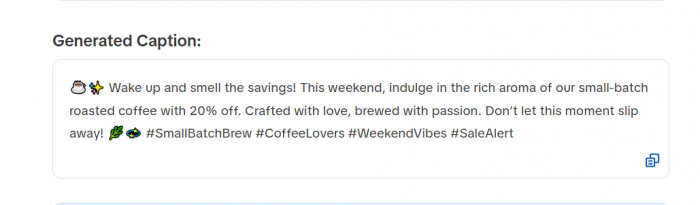
SmartPostly-style output:
☕✨ Wake up and smell the savings! This weekend, indulge in the rich aroma of our small-batch roasted coffee with 20% off. Crafted with love, brewed with passion. Don’t let this moment slip away! 🌿💫 #SmallBatchBrew #CoffeeLovers #WeekendVibes #SaleAlert
Fast, punchy, immediately postable. The hook does its job. But notice the tells "POV:", "future-you," "link in bio" the kind of phrasing that's fine once and formulaic by the fifth post. This is the trade you make for speed.
Predis.ai-style output:
Sip into savings this weekend! Enjoy 20% off our small-batch coffee roasts and treat yourself to a delightful brew. Your weekend just got a whole lot better! Grab your favorite roasts at 20% off and savor the rich flavors of our small-batch coffee. Wake up and smell the savings! This weekend only, enjoy 20% off our handcrafted coffee to fuel your mornings.Get ready for a coffee lover's paradise! Our 20% off weekend sale is here, so you can indulge in our artisanal blends without breaking the bank. Elevate your coffee ritual this weekend! Take advantage of our 20% off sale and discover the magic of small-batch roasting.
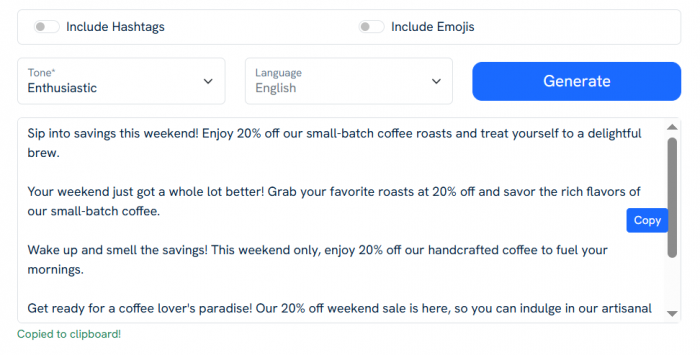
Warmer, more considered, and clearly written to sit under a nice generated image. But look closely: "roasted on Tuesdays," "shipped within 48 hours." I never said either of those things. If they're not true, that's a caption you cannot post as-is and it's polished enough that you might not catch it on a tired Friday. That's the exact risk in miniature.
Two captions, both usable, failing in opposite directions. One is generic but honest. The other is evocative but occasionally makes things up.
The verdict
There's no universal winner here, and any article that gives you one is flattening the actual decision. But "it depends" is a cop-out unless you say what it depends on. So:
| If you're | Pick | Because |
| A short-form creator who already shoots your own content | SmartPostly | You need sharp hooks and fast words, not a visual you didn't ask for. |
| Small business owner who wants the whole post handled | Predis.ai | Caption plus visual plus hashtags in one pass saves the most real time. |
| Team keeping several people on one brand voice | Predis.ai | The persistent brand kit does the consistency work SmartPostly leaves to you. |
| Someone on a tight budget writing lots of captions | SmartPostly | Cheaper entry and request-based pricing suit high-volume text work. |
| A brand where factual accuracy is non-negotiable | SmartPostly | You'd rather de-genericize a true caption than fact-check a pretty one. |
The cleanest way to think about it: SmartPostly is better at captions as a task. Predis.ai is better at captions as a byproduct. If words are the specific thing you're missing, the specialist tends to serve you better. If you're missing the whole post and words are just part of it, the factory earns its price.
One last thought, and it isn't about either tool
After running both through enough briefs, the more interesting question stopped being which is better and became how much of the caption should be theirs at all. The captions I ended up keeping weren't the ones I could publish untouched; they all had a faint machine-smell. They were the ones where the tool got me past the blinking box, and then I changed the one line that made it sound like a person.
That's the honest role for both of these: not a caption writer, but a way to stop staring. The voice still has to be yours, or your audience quietly clocks that it isn't.
Whichever you choose, treat the first draft as a starting line, not a finish. That's the part no tool has figured out how to do for you and honestly, I hope it stays that way.
juliana phil
Aug 28, 2026Reader Testimonial: Lessons From an Online Investment Scam I am sharing my experience in the hope that it may serve as a cautionary example for other investors. I lost more than $740,450 after becoming involved with an online investment opportunity that I later came to believe was fraudulent. The financial loss was substantial, but the experience was also emotionally difficult and left me uncertain about what steps I could take next. After discovering the problem, I sought guidance from Kristina Hooper. I explained what had happened and provided the information I had relating to the transactions and the platform involved. They assisted me in understanding the recovery process and guided me through the steps I needed to take. I recently received my funds back, which was a considerable relief after what had been a very stressful period. Looking back, my experience has reinforced the importance of conducting independent checks before investing online. Investors should verify the identity and legitimacy of a company, be cautious about promises of unusually high returns, and carefully investigate any request for additional payments or personal information. I am sharing this account as my personal experience rather than as a recommendation or guarantee regarding any particular company or recovery service. Anyone wishing to ask about my experience may contact me at kristina hooper24 @ gmail. Dco com
Login To Reply ↪