

Post a video, watch it stall at 400 views, move on. Three weeks later it starts pulling steady traffic from people who typed a question into the search bar. That gap is TikTok SEO: the work of making a video readable to someone searching rather than someone scrolling.
In short, it means putting the exact phrase a person would type into your caption, your spoken opening line, your on-screen text and your hashtags, so TikTok can match your video to their query. This guide sticks to what TikTok has actually documented, marks clearly where the industry is guessing, and gives you a way to test the rest on your own account.
What TikTok SEO Actually Means
TikTok SEO is optimising a video so it surfaces when someone types a query into the app's search bar. It is not about making the algorithm like you more. It is about making a matching system understand which question your video answers.
That distinction changes what you can control. You cannot manufacture interest in your topic. You can make it unmistakable, in four readable places, exactly what your video is about.
One upload now competes on three surfaces: the For You feed, TikTok's in-app search results, and increasingly Google. Each one judges it by different rules.
TikTok Search vs. the For You Page
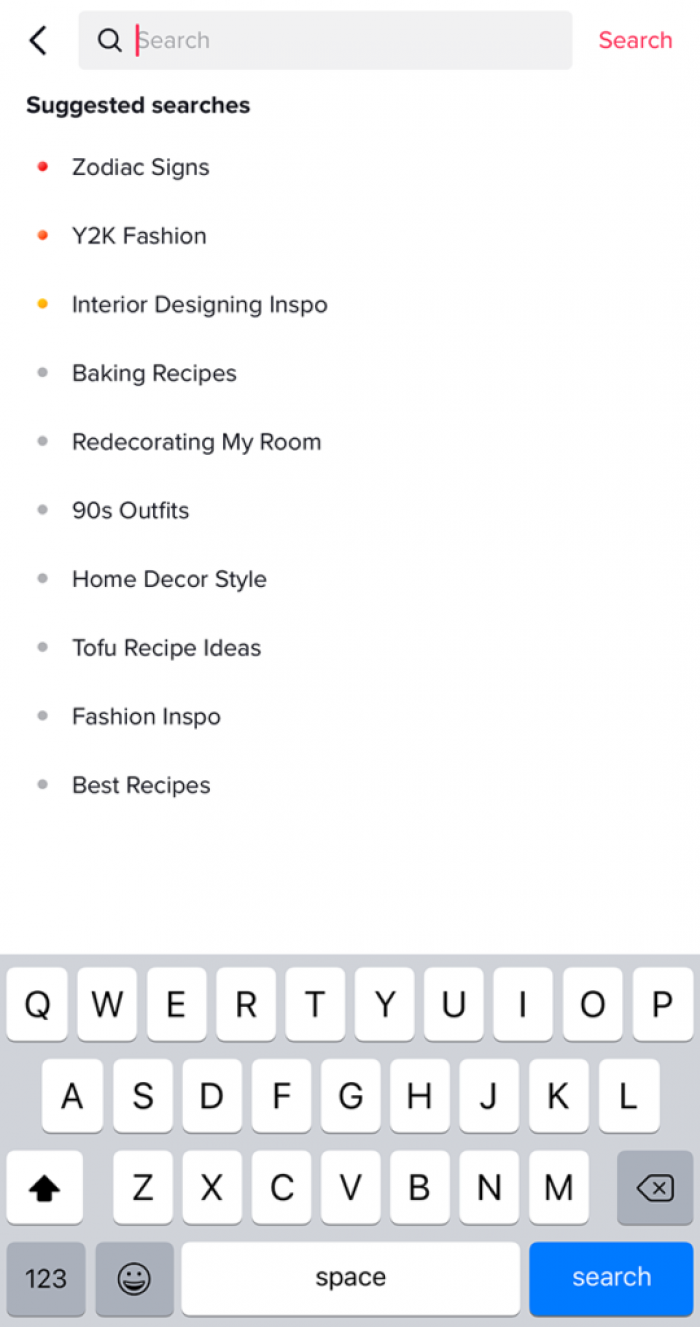
These are two separate ranking systems. Treating them as one algorithm is the most common and most expensive mistake creators make.
The For You feed is push. TikTok predicts what someone might want and serves it before they ask. Search is pull. A person states intent, and TikTok returns what best matches the words they used. A video can fail on the For You page and still rank first in search, and the reverse happens just as often.
| For You Page | Search | |
| How it starts | TikTok decides to show it | A person types a query |
| Main signals | Watch time, completion rate, interaction history | Keyword relevance across caption, text and audio, plus engagement |
| Peak window | First 24 to 72 hours | Builds over weeks and months |
| Shelf life | Short, interest decays fast | Long, recurring demand keeps returning |
| What a flop means | Weak hook or wrong audience | Wrong keyword, or no demand for it |
The practical consequence is uncomfortable: some of your worst-performing videos are your strongest search assets, sitting unoptimised. A clip that got 300 views because it was too specific for the feed may be exactly specific enough to own a query.
How TikTok Reads a Video
TikTok cannot watch your video in any way that helps search. It reads four layers of text and matches them against what someone typed.
● The caption. The text field under your video, and the single strongest place to put your target phrase.
● On-screen text. Words burned into the frame are read by TikTok's systems, so overlays count for search and not only for accessibility.
● Spoken audio. TikTok runs automatic speech recognition on uploads, and that transcript feeds into search ranking alongside the caption.
● Hashtags. A relevance signal, weaker than the three above and badly over-rated by most advice.
Here is the part that rarely gets stated plainly. Optimising one layer is far less effective than making all four agree. A video whose caption, spoken opening, on-screen title card and hashtags all point at the same phrase leaves no doubt. One whose caption says something the audio never mentions is a weaker match, even if each element looks fine alone.
This is agreement between layers, not repetition. You are not stuffing a keyword four times. You are removing ambiguity about what the video is.
Ranking Signals: Confirmed vs. Assumed
TikTok's own guidance is far narrower than the internet suggests. Its Creator Academy describes search results as ordered by relevance to the query and by engagement, with relevance drawn from video captions, video text and hashtags. That is the documented floor. Everything beyond it is observation, inference, or invention.
| Signal | Status |
| Caption keywords, on-screen text, hashtags | Documented by TikTok as relevance inputs |
| Engagement as a sorting factor | Documented, with no published weighting |
| Audio transcription being indexed | Confirmed, TikTok transcribes uploads |
| Follower count | Not a ranking factor, stated directly by TikTok |
| Exact percentage weights per signal | Never published. Any figure quoted is a guess |
| Rewatch-rate and velocity thresholds | Unverified industry folklore |
The follower point deserves its own line, because it is the most encouraging fact in this topic. An account with 200 followers and a precise answer can outrank an account with 200,000 and a vague one.
Finding Keywords People Actually Search
Guessing at keywords is where most effort gets wasted. Four sources give you real demand.
● Creator Search Insights. TikTok's own tool. Search its name inside the app and tap View. It shows topics people search frequently and flags topics that are short on content. Those content-gap topics are the most valuable thing in there.
● Search bar autocomplete. Type a partial phrase and read the suggestions. These are real queries, ordered by what TikTok expects you want.
● Your own comments. The most under-used keyword source available. Every "but how do you..." reply is a query someone typed somewhere, phrased in their own words.
● "Others searched for". Sits at the foot of a results page and maps the neighbouring questions around your topic.
One correction worth making, because the mistake is everywhere: the Keyword Insights tool in TikTok's Creative Center draws on advertiser data, not organic posts. It reports how many advertisers used a term in ad copy, voiceover or text overlay, not how many users searched it. It is a copywriting tool. Reading it as search volume will send you chasing phrases nobody types.
Picking Keywords Worth Making a Video For
Volume alone is a poor filter. A query with huge demand and a thousand strong videos already answering it is a worse target than a modest query with four weak ones.
Run every candidate through four questions.
● Can you answer it properly in under sixty seconds? If the honest answer needs ten minutes, the video underdelivers and retention collapses.
● Does the answer actually need video? Some questions are better as text, and searchers work that out within two seconds.
● Is it a question or just a topic? "Skincare" is a category. "Is niacinamide safe with retinol" is a query.
● Would a searcher watch to the end? Search traffic arrives with a specific need. Half an answer sends them straight back to the results page.
Searchable and watchable are not the same thing. TikTok search works hardest for how-to, comparison, "is it worth it", location-specific and honest-review content. It works poorly for pure entertainment, where demand is enormous but nobody types anything to find it.
Writing Captions for Search
Lead with the phrase. When writing TikTok captions for search, lead with the target phrase. Do not bury it behind a hook, an emoji run, or unnecessary context. The front of the caption is the clearest statement of relevance you get.
Write it as an answer, not a tease. A caption that withholds performs well in the feed and badly in search, because a searcher is confirming they have landed in the right place before committing any attention.
| Weak caption | Stronger caption |
| this changed everything for me 😭 | how to fix a cracked phone screen without replacing it |
| storytime: my worst flight ever ✈️ | what happens if you miss a connecting flight on a separate ticket |
| POV: your plants hate you | why monstera leaves turn yellow and how to stop it |
Use one primary phrase and at most one natural variant. Stacking six near-identical keywords reads as spam to humans, and humans still decide whether to watch.
Spoken Keywords and On-Screen Text
Say your target phrase out loud in the first few seconds, in plain words. Not a paraphrase, the actual phrase someone would type. The transcript picks it up, and the viewer gets instant confirmation they are in the right video.
Put the same phrase on screen as a title card, legible, held long enough to be read. This doubles as accessibility work, which is a rare case of two goals pulling the same direction.
Then verify. Two days after posting, search your own keyword and see whether your video appears anywhere in the results. If it does not surface at all, the problem is relevance rather than reach, and reposting will not fix a video TikTok has not understood.
Hashtags and Their Real Role
Hashtags are a relevance signal, not a distribution lever. They tell TikTok what category you sit in. They do not push your video anywhere.
Effective hashtag research prioritises relevance over popularity. Three to five specific tags tied to your actual topic are more useful than twenty broad ones. Generic tags such as #fyp, #viral and #foryoupage add little context about your video's subject.
A simple test: if a hashtag is not something a real person would type while looking for your video, it is not earning its place.
Structuring a Video for Search Intent
This is where search optimisation collides with everything the feed taught you.
A search viewer already knows what they want. They do not need a hook to create curiosity. They need fast confirmation that this video answers the question they just typed. Front-load the answer, deliver the core of it inside the first ten seconds, then expand on it.
That means dropping retention tricks that work beautifully on the For You page. "Wait for it" and "follow for part two" are search poison. Someone who came for an answer and got a cliffhanger leaves immediately, and that exit reads as a bad match. Engagement bait has lost value broadly, but in search it actively works against you.
Open with a title card stating the question. It is read by the viewer and by the index at the same moment, which is the cleanest piece of double duty available to you.
Building Topical Authority
TikTok appears to favour accounts that have published several videos on a related topic when ranking search results for that topic. One video on a subject is harder to rank than six covering it from different angles.
● Build clusters, not one-offs. Pick a topic and make five or six videos that each answer a different query inside it, rather than one trying to cover everything.
● Name playlists after queries. A playlist is a search surface in its own right, so a keyword-led name works harder than a clever one.
● Treat your bio and display name as indexed text. "Sarah | Sourdough for beginners" is readable. "✨ living my best life ✨" is not.
● Pin the video that answers your main query, so your profile behaves like a landing page for it.
There is a real trade here. Topical authority rewards specialisation, which means the creator who posts whatever they feel like will lose search to the one who picked a lane and stayed in it. Whether that trade suits you depends on what you want from the platform, but make it knowingly rather than drift into it.
Reading Your Search Analytics
TikTok reports search data specifically, and most creators never open it. Search Analytics shows search views, search view percentage, search impressions, average click-through rate and average search ranking.
| What you see | What it means | What to fix |
| Low search impressions | TikTok is not matching you to queries at all | Relevance: rewrite the caption, restate the phrase in the audio |
| High impressions, low CTR | You rank, but nobody picks you | The cover frame and the opening words of the caption |
| Good CTR, poor retention | The video does not deliver what the query promised | The answer itself, and how early you give it |
| Average ranking stuck low | Stronger videos already own the query | Target a narrower version of the same question |
One honest caveat. TikTok publishes no benchmarks for any of these numbers, so compare each video against your own earlier videos. Any "good" figure quoted elsewhere was invented by someone who needed a number for their blog post.
Getting Found Outside TikTok
Your caption is now metadata for more than one search engine. Google surfaces TikTok videos in its own results and draws on TikTok content for AI Overviews, and short-video carousels on Google mix TikTok clips with Reels and Shorts across a wide range of queries.
TikTok video titles and captions now appear in standard Google results, so a vague, emoji-heavy caption costs you visibility twice. It also means older evergreen videos are worth revisiting with clearer captions, since they carry search value they did not have when you posted them.
Inside the app, one change is worth watching. TikTok has been testing AI-generated snippets at the top of some search results pages. If the app answers the question before anyone reaches the videos, ranking first starts to mean something different. Nobody can tell you yet how that settles, which is a good reason to build an audience that returns to you by name and not only by query.
Where TikTok SEO Fails
Search is not a universal fix, and guides that present it as one are selling something.
● Entertainment niches get far less from it. Comedy, dance and storytelling have enormous demand and almost no search intent. Nobody types a query to find a joke.
● Keyword-first content can go flat. Build every video around a phrase and you will make things that rank and nobody enjoys, which eventually costs you the engagement half of the equation.
● Over-optimised captions read as spam. The index may tolerate them. People scrolling past will not.
● Search cannot rescue a weak video. It decides who finds you. It has no opinion on whether they stay.
Search is a distribution layer, not a content strategy. Worth real effort, and worth knowing its limits.
A Repeatable Weekly Workflow
1. Pick one query from Creator Search Insights, autocomplete, or your comments, ideally one with demand and thin competition. (15 minutes)
2. Confirm it is a question, not a topic, and that you can answer it in under a minute. (5 minutes)
3. Write the caption first. If you cannot write a clear one, the video idea is not clear either. (10 minutes)
4. Build the video around that caption, with the phrase spoken in the opening line and shown as a title card. (filming time)
5. Search your keyword after 48 hours to confirm you have been indexed. (2 minutes)
6. Open Search Analytics on day seven and diagnose using the table above. (5 minutes)
7. Decide: repeat, revise, or drop. Queries that worked earn a cluster. Ones that failed get one rewrite, then get abandoned.
Quick checklist before you hit post: target phrase at the front of the caption, spoken aloud in the first few seconds, shown as on-screen text, supported by three to five specific hashtags, with the answer delivered inside ten seconds.
The Verdict
TikTok SEO is real, narrower than the industry claims, and more accessible than almost anything else on the platform. You do not need followers, a trending sound, or luck with the feed. You need a question people genuinely type, an answer worth sixty seconds, and four layers of your video saying the same thing clearly.
What it will not do is replace the work of being worth watching. The creators who gain most from search were already making something useful and simply stopped hiding what it was about. Pick one query this week, optimise one video properly, and check the analytics on day seven. One honest data point from your own account is worth more than a year of reading about everyone else's.
Comments