

Blackbox AI's ads followed me around the internet for months. Reddit kept insisting the tool behind those ads is a scam. Both could not be right.
So I paid the $2 first-month promo, installed the VS Code extension, and spent a week testing every major claim the company makes about itself. This review covers what Blackbox AI actually is, how it works, what it costs, what real users say across six platforms, and the one problem that has nothing to do with code.
Quick Verdict
| Rating | 3.5 / 5 |
| What it is | A multi-model AI coding assistant that runs your request through several frontier models at once and returns the best result |
| Starting price | Free tier; Pro at $10/month ($2 promotional first month) |
| Best for | Students, budget-conscious solo developers, and anyone who wants Claude, GPT, Gemini, and Grok under one $10 subscription |
| Avoid if | You need consistent output on complex multi-file work, handle proprietary client code on a lower tier, or have low tolerance for billing surprises |
| The one thing to know | The product is real and useful. The billing and cancellation experience is the source of its 2.7/5 Trustpilot rating |
What Blackbox AI Actually Is
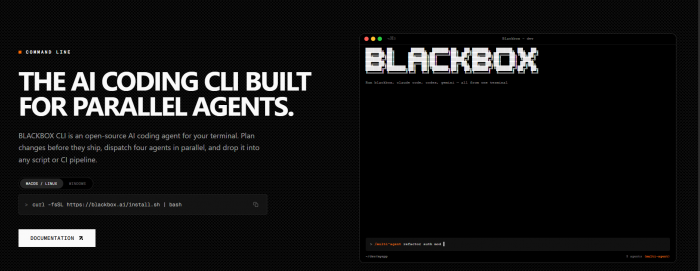
Blackbox AI is easy to misjudge because it is not one product. It is six connected surfaces sharing a single account: a web chat, extensions for VS Code and JetBrains, its own Blackbox IDE, a CLI agent for the terminal, cloud-based remote agents, and a mobile app.
The honest way to categorize it: Blackbox is less a rival to Claude or GPT and more an orchestrator sitting on top of them. Your subscription buys metered access to over 300 models, including Claude Sonnet, GPT, Gemini, and Grok, all routed through one interface.
Whether that routing adds real value is exactly what I set out to test.
How It Works: The Chairman LLM System
Blackbox's core mechanism is what it calls Chairman LLM, and it is the genuinely novel idea here.
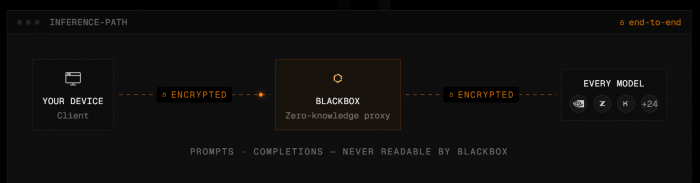
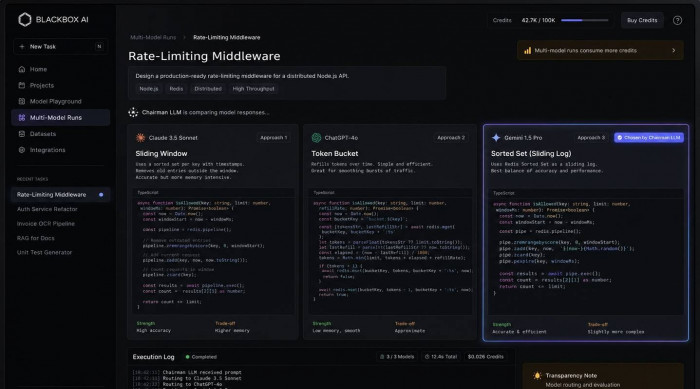
Instead of sending your prompt to one model, the system dispatches the same task to several models in parallel, typically Claude Code, OpenAI Codex, and Blackbox's own models. A supervising "chairman" model then evaluates every candidate on correctness, performance, risk, and complexity, and returns the winner.
For context handling, Blackbox can import full folders, files, commits, and URLs, and it builds a semantic knowledge graph of your project for longer agent runs inside isolated sandbox environments.
The agent itself operates in two modes:
● Manual Mode keeps you in control, letting you approve or reject every individual action before it touches your files.
● Auto Mode lets the agent generate its own task plan and execute it autonomously, which is faster but demands trust the tool has not fully earned yet.
Key Features at a Glance
Beyond the multi-model core, these are the features that define the platform in 2026:
● Code chat and autocomplete across the web, VS Code, and JetBrains, with the VS Code extension alone sitting at around 4.7 million installs.
● Vision-to-code, which converts Figma screenshots, UI mockups, or hand-drawn sketches into HTML/CSS/Tailwind or React frontend code.
● CLI agent that translates natural language into file edits, git operations, and repo tasks directly in your terminal.
● Remote agents that run long jobs in the cloud so your local machine stays free while tasks execute.
● Voice Agent for hands-free commands like "explain this error" or "refactor this method."
● Screen Share Agent for collaborative debugging sessions.
● App Builder for generating boilerplate applications and UI components on the higher tiers.
● Automated testing and documentation, generating unit, integration, and end-to-end tests using Jest or Cypress, plus docs for undocumented code.
IDE coverage is the broadest in the category. Beyond VS Code and JetBrains, it supports Android Studio and Xcode, which very few competitors do.
Getting Started: What the First Hour Feels Like
Setup is genuinely painless. You can use the web chat without even creating an account, which is rare, and the VS Code extension had me running in minutes.
The interface is a single prompt box with a model selector and an attachment clip for images. There are no separate feature menus to learn, which cuts both ways. It feels simple on day one and vague on day three, because discovering what the agent can actually do takes trial and error.
The learning curve is real for the advanced features. The multi-agent system and the CLI both assume you already think like a developer, so complete beginners will find tools like ChatGPT friendlier for learning.
Claim 1: "Code 10x Faster"
This is the headline promise, and it rests on the autocomplete and chat experience.
For boilerplate, common patterns, API integrations, and repetitive structures, it saves real time. Completions arrive fast, and benchmark tests have clocked it up to twice as fast as Copilot on response speed.
The claim wobbles on nuanced, project-specific logic. Cursor and GitHub Copilot both produce noticeably tighter suggestions because their codebase indexing runs deeper. Blackbox's context awareness is decent but shallower on large repositories.
Verdict: partially true. You will code faster on routine work. The 10x figure is marketing arithmetic, because on complex logic the saved time goes into reviewing the output.
Claim 2: Chairman LLM Picks the Best Answer
When it works, it works. Asking for a rate-limiting middleware produced three structurally different approaches (sliding window, token bucket, sorted-set based), and the selected answer was the one I would have picked myself.
For a developer who cannot afford separate Claude, ChatGPT, and Gemini subscriptions, getting a committee of them for $10 to $20 a month is legitimately strong value.
Two caveats keep this from being a clean win:
● Parallel dispatch burns credits fast. Every multi-model run draws from your monthly credit pool, and users consistently report credits draining quicker than expected, with no rollover to the next month.
● Multiple users have publicly alleged that the model advertised is not always the model served, claiming requests labeled as Claude Sonnet returned output resembling the smaller Haiku model. This has not been proven, and I could not conclusively verify it, but the allegation recurs often enough across Trustpilot and Reddit that it belongs in any honest review.
Verdict: mostly true, with an asterisk on transparency. You cannot fully audit what happens behind the curtain, which is an ironic problem for a company named Blackbox.
Claim 3: Turn Any Design Into Working Code
The vision-to-code output looks impressive on first render. Layouts, spacing, and component structure come through accurately, and for landing pages or static sections this is a real shortcut.
The limitation appears the moment the interface needs to do something. Independent testers keep finding what I found: the generated frontend has no working logic behind it. Buttons connect to nothing, forms submit nowhere, and there is no state or data scaffolding.
Verdict: true for prototypes, misleading for products. Treat it as a mockup-to-markup converter, not an app builder.
Claim 4: An Autonomous Agent That Ships Tasks End to End
The most useful reliability data comes from independent benchmarking: Blackbox's autonomous agent needs roughly 30 to 40 percent manual review on complex work, versus under 10 percent for Cursor's agent.
My week matched that ratio. Single-file refactors, Jest test generation, and documentation tasks landed cleanly. Ambitious multi-file changes needed enough correction that Manual Mode is the only mode I would trust on a codebase that matters.
Verdict: true for contained tasks, not yet true for autonomy. It is a competent junior developer who needs code review, not a senior one you can leave alone.
The Other Business: Blackbox as an API Platform
Blackbox is no longer just a coding assistant. It also sells inference.

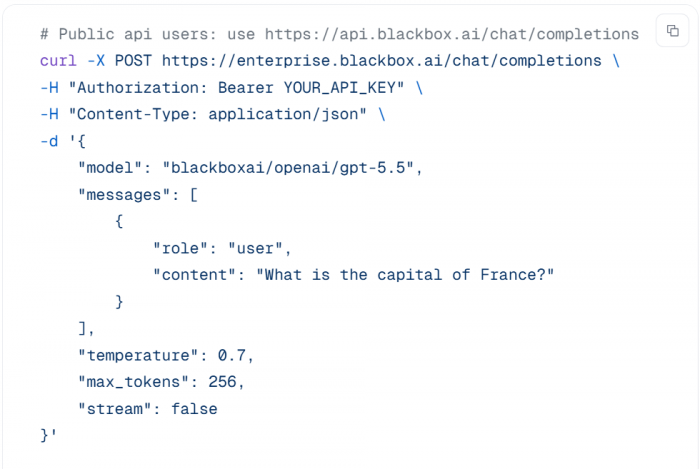
Its API offers a single access point for multiple coding agents, letting teams run Claude Code, Codex, and Blackbox agents through one bill and one audit trail. The company claims encrypted inference with customer-managed keys and zero data retention on this layer.
There is even independent validation on the performance side. Artificial Analysis benchmarked seven providers serving NVIDIA's Nemotron 3 Ultra 550B and ranked Blackbox first on output speed, time to first token, and blended price simultaneously.
For most individual developers this is irrelevant. For teams evaluating inference providers, it signals the company's engineering is more serious than its consumer reputation suggests.
Pricing: Cheap Entry, Fine Print Everywhere
Blackbox restructured its pricing in 2026, retiring the old $8 Pro and $100 Ultimate tiers.
| Plan | Price | What you get |
| Free | $0 | Unlimited basic chat and autocomplete, limited daily use of premium features |
| Pro | $10/month ($2 first month) | $10 in model credits across Claude, GPT, Gemini, and Grok, plus Voice Agent and Screen Share Agent |
| Pro Plus | ~$16 to $20/month | $20 in credits, Multi-Agent Execution, App Builder, Coding Agent across 35+ IDEs, Remote Agent, Slack integration |
| Pro Max | $40/month | $200 in credits, unlimited agent requests, team features, SAML SSO, priority support |
| Enterprise | Custom | On-premise deployment, training opt-out by default, dedicated support with SLAs |
Annual billing takes roughly 20 percent off. Three things the pricing page does not make obvious:
● Unused credits expire monthly rather than rolling over, so light users effectively pay for capacity they never touch.
● Auto-Refill is enabled by default at the Pro Plus tier, meaning the system tops up your credits and charges your card when you run out unless you manually switch it off.
● The official pricing documentation is vague enough that most published reviews, this one included, cross-reference third-party sources to pin down tier details. Verify current numbers on blackbox.ai before subscribing.
The entry cost is not the problem. What happens when you try to leave is.
Real User Reviews: The Most Split Reputation in Dev Tools
Blackbox has the most polarized reputation of any developer tool I have researched, and the split follows a clean pattern. Platforms where developers rate the product score high. Platforms where consumers rate the company score low.
| Platform | Rating | Sample |
| G2 | 4.4 / 5 | Active developer reviews |
| Software Advice | 4.5 / 5 | 49 reviews |
| Google Play Store | 3.7 / 5 | 5,000+ reviews |
| Chrome Web Store | 2.7 / 5 | 1,200+ reviews |
| Trustpilot | 2.7 / 5 | ~99 reviews, recent snapshots as low as 1.9 |
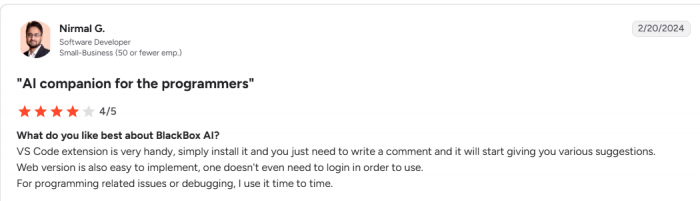
The positive reviews are real. On G2, a software developer describes pairing the web version with the VS Code extension to ship cleaner code faster on deadline.
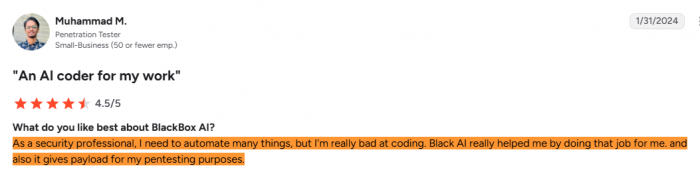
A security professional reports that automation and pentesting scripts which used to eat hours now take under a minute.
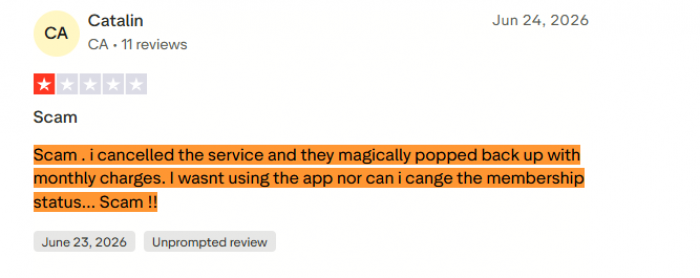
The negative reviews are just as real, and they are almost never about the code. Recurring, documented Trustpilot complaints include:
● Charges appearing after cancellation, including one user billed twice within seconds roughly four months after cancelling, and another still charged monthly five months after closing the account.
● Free trials converting to paid charges despite cancellation before the trial ended, followed by unresponsive support.
● No confirmation emails for charges or cancellations, leaving users without a paper trail when disputing a charge.
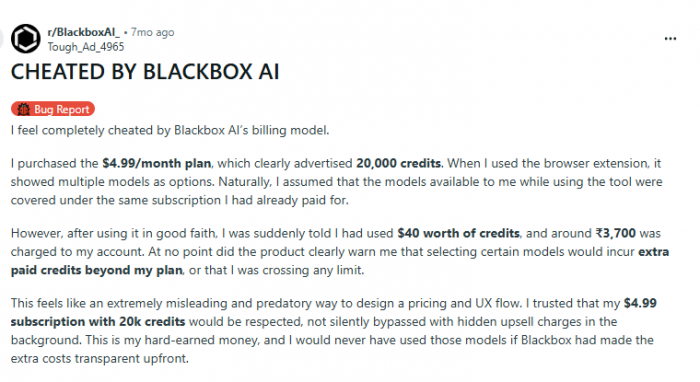
● A $4.99 plan advertising 20,000 credits that did not behave as advertised once the user started working.
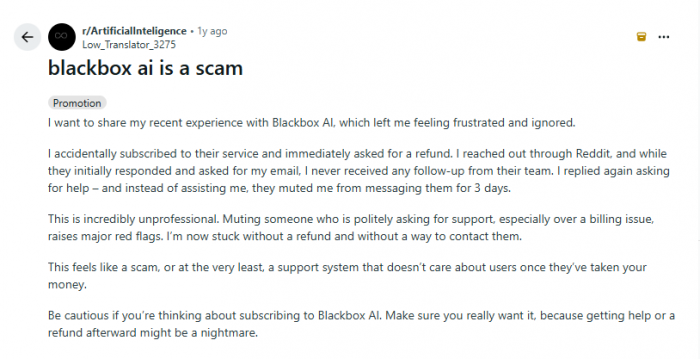
On Reddit, the picture is scrappier. Users are openly hostile to Blackbox's aggressive ad campaigns, at least one thread on r/ArtificialIntelligence is literally titled "blackbox ai is a scam," and one common refrain is that Claude alone codes better. reddit
Support: Effectively One Channel
Customer support deserves its own short section because it compounds every billing problem above.
Users report that email support goes unanswered for weeks, and that X is effectively the only channel where the company responds. One user only got wrongly removed API credits restored after making the issue public on social media.
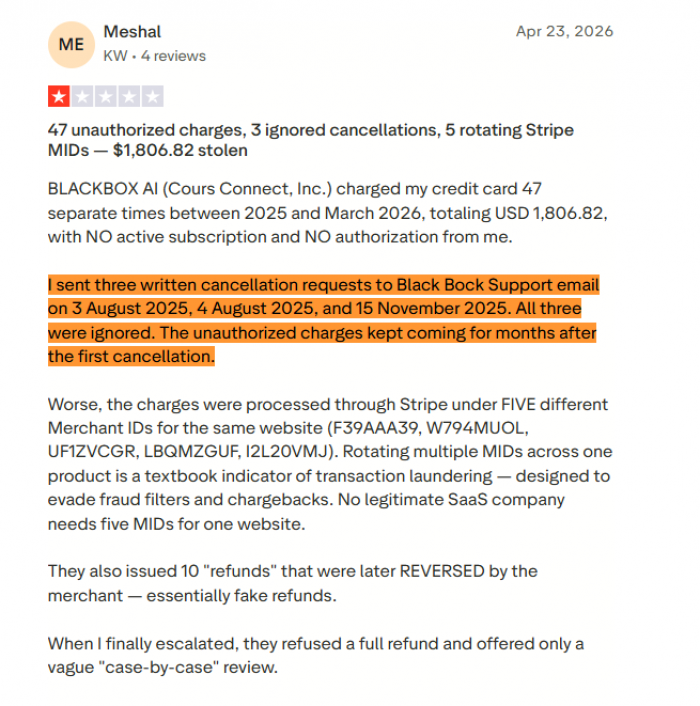
There is also no self-service account deletion option, according to reviewers, which is a strange gap for a developer-focused product in 2026.
Security and Privacy: Read This Before Pasting Client Code
This section is missing from most Blackbox reviews and matters more than any feature comparison.
Blackbox processes your code through cloud APIs and does not publicly list SOC 2 or equivalent third-party security certifications. More importantly, training opt-out is reserved for Enterprise plans. Code submitted on Free, Pro, and mid tiers may be used for model improvement.
The company markets an end-to-end encrypted Desktop Agent as a workaround for sensitive work, plus zero data retention on its API layer. Those claims are plausible but unaudited.
The practical rule for freelancers and agencies handling code under NDA: keep proprietary code off the lower tiers, or use a competitor built for privacy.
If You Subscribe: A Three-Step Safety Checklist
None of this should be necessary for a legitimate product, and the fact that it is remains Blackbox's biggest liability. But if you do sign up:
● Disable Auto-Refill immediately after subscribing, before you run your first big agent task.
● Screenshot your cancellation confirmation screen when you leave, since users report no confirmation emails are sent.
● Watch your card statement for at least two billing cycles after cancelling, and dispute promptly through your bank if a charge appears.
Who Blackbox AI Is Actually For
Students and learners are likely to get the most value from Blackbox AI. Its free plan offers generous access to basic AI chat, while the affordable Pro subscription provides multiple frontier AI models at a price that is difficult to match. For coursework, personal projects, and experimenting with different models, it delivers excellent value.
Budget-conscious solo developers and freelancers are another strong audience. Blackbox AI is well suited for prototyping, debugging, code generation, and handling routine development tasks without requiring an expensive subscription. However, users working with sensitive client projects should carefully review the platform's privacy policies before sharing confidential code.
Professional developers working on production codebases may find Blackbox AI most useful as a secondary coding assistant rather than their primary tool. Its access to multiple AI models makes it valuable for comparing solutions, generating alternative approaches, and getting a second opinion. However, dedicated coding assistants such as Cursor or GitHub Copilot still offer a more mature experience for day-to-day production development.
Teams operating in regulated industries may find the platform less suitable unless they opt for the Enterprise offering. Features such as advanced compliance controls, stronger privacy options, and enterprise deployment capabilities are limited on lower-tier plans, making it a less practical choice for organizations with strict security and regulatory requirements.
Complete beginners may also face a steeper learning curve. While Blackbox AI is powerful, its multi-agent workflows, developer-focused interface, and command-line tools can feel overwhelming for someone who is just starting to learn programming. Beginners often benefit more from coding assistants with simpler interfaces and guided learning features.
Alternatives Worth Considering
The market has a direct answer for each concern this review raised:
● GitHub Copilot ($10/month) if the billing reputation is your dealbreaker. Same entry price, training opt-out by default, IP indemnity on business plans, and a boring, predictable subscription.
● Cursor ($20/month) if output quality on complex work matters most. Deeper codebase indexing, multi-file editing via Composer, and an agent needing a fraction of the manual review.
● Windsurf ($20/month) if you want an agent that explains its plan before touching your code. Acquired by Cognition, the makers of Devin, in December 2025.
● Tabnine ($9/user/month) if privacy is non-negotiable. The only mainstream option with fully air-gapped deployment where code never leaves your infrastructure.
● Claude if you value planning, reasoning, and explanation over hands-on IDE execution.
Frequently Asked Questions
Is Blackbox AI legit or a scam?
The product is legitimate and used by millions of developers. The scam accusations stem almost entirely from billing practices: charges after cancellation, disappearing credits, and unresponsive support. The code is real, the subscription needs watching.
Is Blackbox AI free?
Yes. The free tier includes unlimited basic chat and autocomplete, with limited daily access to premium features. Exact limits are not publicly documented.
Does Blackbox AI train on my code?
On Free, Pro, and mid tiers, your code may be used for model improvement. Opt-out is available only on Enterprise plans, with the encrypted Desktop Agent as a partial workaround.
Is Blackbox AI better than ChatGPT for coding?
For hands-on execution inside an IDE, yes. Blackbox lives in your editor, reads your open files, and runs multi-file edits. ChatGPT remains stronger for high-level planning, learning, and explaining complex logic.
Final Verdict: The Ads and Reddit Were Both Half Right
After a week inside Blackbox AI, my answer to the question I started with is that neither side was lying. They were describing different halves of the same company.
The ads describe a real product. The Chairman multi-model architecture is a legitimately clever idea, the IDE coverage is the broadest in the category, and at $10 a month it delivers more raw model access than anything else I have used.
Reddit describes a real company. Its billing practices, vanishing credits, and one-channel support have earned a consumer reputation the engineering does not deserve.
I am keeping my subscription for one more month, with Auto-Refill disabled and a calendar reminder to check my card statement. That sentence is the whole review in miniature.
Rating: 3.5 / 5. Great value, real innovation, and a trust problem entirely of its own making.
Comments