

I don't have an X account anymore, and I don't want one. But my work doesn't care about that. I track AI tool launches for a living, and half of them still get announced in a founder's thread before they show up anywhere else. Every time I clicked one of those links, X slammed a login wall in my face.
That's how I ended up on Sotwe. Not through a listicle, not through curiosity through irritation. And instead of using it twice and forming an opinion, I did something slightly unreasonable: I made it my only way to read Twitter content for three weeks and took notes on everything.
This review is the result. What Sotwe actually does, where it quietly works, where it loudly breaks, whether it's safe, and who should genuinely use it. No feature list copied from the homepage. Just what happened.
What Sotwe Actually Is (and the One Design Choice That Explains Everything)
Sotwe is a free, anonymous Twitter/X viewer. You open the site, type a username or keyword, and read public tweets, profiles, media, and trends no account, no app, no signup. That's the entire pitch.
The part most reviews skip is how it does this, and it matters more than any feature. Sotwe doesn't use X's official API. It fetches public data through its own servers and rebuilds it in its own interface. X never approved this arrangement and actively works against tools like it.
That single design choice explains everything you'll read below:
● Why it's free and frictionless there's no API bill to pass on to you and no account system to maintain
● Why it breaks without warning every time X changes its platform plumbing, Sotwe's scraping pipeline snaps until someone patches it
● Why access feels inconsistent the site sits behind aggressive filtering that treats different devices and browsers differently
● Why there's no one to complain to no company accountable to you, no support inbox, no status page worth the name
One more expectation to set before we go further: Sotwe is read-only. You can't post, reply, like, follow, or DM anyone through it, and you never will those actions require an authenticated account by definition. Sotwe replaces the reading half of Twitter, nothing else. If that sounds obvious, good; a surprising number of people arrive expecting a full alternative client and leave disappointed.
Keep that in mind as you read. Sotwe's strengths and weaknesses aren't separate lists. They're the same fact viewed from two sides.
Getting Started: There Is No Setup, but There Is a Trap
The onboarding section of this review is almost embarrassingly short. You go to sotwe.com, you see a search bar, you type. There's no registration, no email confirmation, no cookie-wall negotiation beyond the usual consent banner. From landing to reading someone's timeline took me under ten seconds.
But there's a trap before you even get there, and nobody warns you about it: the domain situation is a mess. Search "Sotwe" and you'll find lookalike sites sotwe.store, various "official link" pages, mirror directories all claiming to be the real thing or to point to it. Some are harmless link farms chasing the same search traffic. Others are exactly the kind of clone site you should never touch.
My rule after three weeks: sotwe.com is the site. If any page calling itself Sotwe asks you to log in, enter an email, or install anything, close the tab. A viewer that exists so you don't need an account has no business asking for credentials.
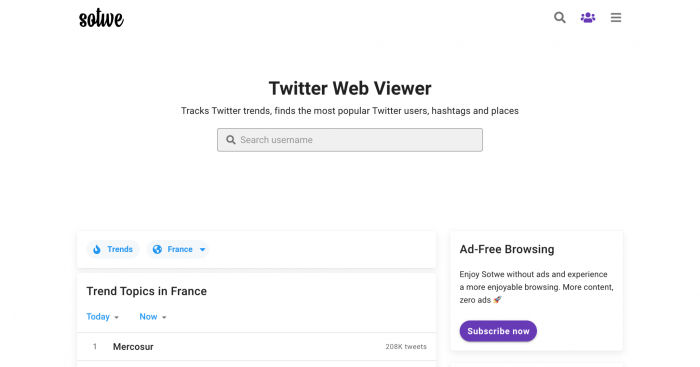
First impressions once you're in: the interface is functional rather than pretty. Tweets render in a clean enough card layout, profiles show follower counts and bio info, and search is front and center. The ads, however, announce themselves immediately more on that in the pricing section, because the ads are the pricing.
Core Features, Actually Tested
I put every major feature through real use not a five-minute demo, but the kind of repeated daily usage that surfaces the annoying stuff. Here's how each area held up.
Profile and Timeline Browsing
This is the core job, and when Sotwe is up, it does it well. I followed about a dozen accounts through the viewer during my test: AI founders, a couple of tech journalists, two very high-volume news aggregators. Recent tweets loaded quickly, threads were readable, and engagement counts displayed correctly as far as I could verify against cached versions.
The cracks show when you scroll deep. On accounts with tens of thousands of tweets, going far back in the timeline introduced noticeable lag, the kind where you scroll, wait, watch a spinner, and question your choices. For checking what someone posted this week, it's fine. For archaeology on a five-year-old account, it's painful.
Search and Trends
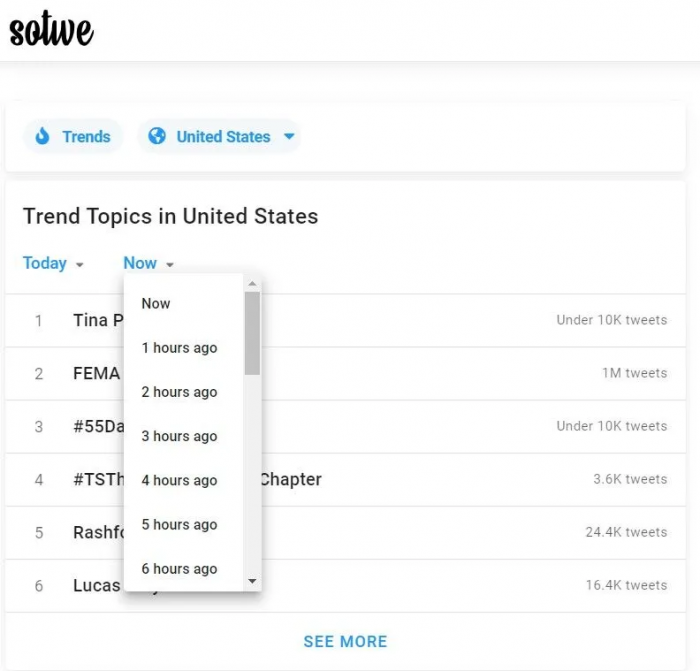
Search works, but it has a temper. Several times during my test, typing a query threw a "Please try again" error, and the little reload button next to the error did nothing. The fix, weirdly, was refreshing the entire browser tab after which the same search worked instantly. Once I learned the ritual, it stopped bothering me, but a new user hitting this on their first visit would reasonably conclude the site is broken.
Trend browsing is a quiet strength. Being able to check what's trending including region-specific trends without an account and without X's engagement-bait algorithm deciding what I should care about was genuinely refreshing. If I keep Sotwe for anything long-term, it's this.
One search limitation worth stating plainly: this is a viewer, not a research tool. There are no advanced operators, no date-range filters, no export. You can find an account or a keyword's recent tweets; you cannot slice historical data the way X's own advanced search allows. If your search needs go beyond "show me what this person or topic looks like right now," you'll outgrow Sotwe in an afternoon.
Media Viewing and Downloads
Images loaded reliably for me on most days, though I hit one stretch where thumbnails rendered but full images wouldn't be a known complaint I later found echoed by other users. Videos played back fine for short clips.
Downloads are where expectations need managing:
● Images and short videos: worked consistently. Right-click-adjacent simplicity, no watermarks added.
● Videos over roughly five to six minutes: unreliable. Downloads stalled or failed often enough that I stopped trying. If saving long videos is your actual use case, a dedicated Twitter video downloader will serve you better Sotwe treats downloading as a side feature, and it shows.
Mobile Experience
Sotwe has no app, which I count as a positive nothing to install, no permissions to grant, works on anything with a browser. On Android Chrome, the experience nearly matched desktop: profiles loaded correctly, downloads worked. On iPhone Safari, everything functioned but felt a step slower.
The layout is where mobile falls short. Elements feel compressed on a small screen, and downloading media takes a few more taps than it should. Rotating to landscape improves video viewing considerably. It's usable daily I did exactly that during the blocked-on-desktop stretch you're about to read about but it's clearly a desktop site that tolerates phones rather than one designed for them.
Here's the feature picture in one view:
| Area | Verdict | The catch |
| Timeline browsing | Works well | Lags badly on deep scrolls of huge accounts |
| Search | Works | Random "try again" errors; fix is a full tab refresh |
| Trends | Genuinely good | None worth noting |
| Image viewing | Reliable | Occasional days where full images fail to load |
| Video downloads | Hit and miss | Fails often on videos longer than ~5–6 minutes |
| Mobile browsing | Usable | Compressed layout, slower on iOS, extra taps |
Performance and Reliability: The Section That Decides Everything
If you read only one section, make it this one. Sotwe's feature set is decent. Its reliability record is the reason you can't build anything on it.
The Outage History Is Real
This isn't a tool with occasional hiccups. In early 2025, a widely documented disruption took Sotwe down for days not hours, days. Shorter outages have recurred since, including during 2026. When X changes something on its end, Sotwe doesn't degrade gracefully. It stops, and it stays stopped until someone on the other side patches the pipeline. There's no ETA, no status update, no communication at all. The site is simply gone, and then one day it's back.
The Windows Blocking Incident
The strangest thing I encountered and the thing that made me realize how odd Sotwe's situation is happened in week two. Sotwe stopped loading on my Windows desktop entirely. Cloudflare block page: "Sorry, you have been blocked." Different browsers, same result. Cleared cache, tried incognito, nothing.
Same URL, same Wi-Fi network, same IP address opened instantly on my phone.
I assumed I'd done something to get flagged until I found other users reporting the identical pattern: blocked on Windows regardless of browser, working fine from Android, iOS, or Linux on the same connection. The prevailing theory is that the filtering detects the operating system during the TLS handshake before your browser even matters and blocks Windows traffic wholesale during certain periods. Whether that's Sotwe defending itself from bots or something clumsier, the practical effect is the same: your access can vanish based on your operating system, and no troubleshooting on your end will fix it.
What This Means in Practice
Stack it up honestly:
● Multi-day total outages have happened and will happen again the architecture guarantees it
● Access can break per-device or per-OS with no explanation and no fix except switching hardware
● The search error, the image-loading failures, and the deep-scroll lag are minor individually but constant collectively
● The domain itself may change over time, forcing users to hunt for the current working address
None of this is a bug that a future update fixes. It's the permanent operating condition of an unofficial viewer living entirely at X's mercy. Sotwe works until it doesn't, and you get no vote on when that is. Any workflow that depends on consistent access brand monitoring, research pipelines, anything with a deadline is disqualified on this section alone.
Privacy, Safety and the Legal Question
Three separate questions people mash together. Here they are, separated.
What anonymity do you actually get?
A real but limited kind. X doesn't know who you are, no account, no login, no profile tied to your reading habits. That's the entire value proposition, and it delivers. But "anonymous to X" isn't "invisible." Sotwe runs ad networks, and ad networks track. Your ISP still sees you visiting the site. If you want genuine privacy rather than just accountlessness, pair it with your usual measures. On its own, it hides you from X's profile-building, not from the internet.
Is it safe to use?
The real site, used sensibly, yes. The dangers live at the edges: clone domains impersonating it, and the ad load itself, which can include the sketchy tier of programmatic ads. Two rules cover you almost entirely. Never enter credentials, emails, or personal details on Sotwe or anything claiming to be it, a legitimate viewer never needs them. And don't install anything a Sotwe-branded page offers you, because the real tool has nothing to install.
Is it legal?
This is the gray zone, and I'll describe it honestly rather than pretend certainty. Viewing publicly available data is not illegal in most jurisdictions. But Sotwe's method of scraping X without permission almost certainly violates X's terms of service. That's a problem between Sotwe and X Corp, not typically between you and anyone. There's no realistic scenario where reading public tweets through a viewer creates legal exposure for an ordinary user, but if your use is commercial or at scale, you should know you're building on terms-violating infrastructure. I'm not a lawyer, and if your situation is unusual, ask one.
Pricing: It's Free, and the Ads Are the Price
There's no premium tier, no subscription, no upsell. Sotwe costs nothing, ever.
What you pay instead is attention. The free experience is ad-heavy banners, interstitials, the works and on some days the ad density genuinely competes with the content. I found it tolerable on desktop with the reading area centered, more intrusive on mobile where screen space is scarce.
The other cost of free is one people forget: you're owed nothing. No support, no uptime promise, no data-handling accountability, no one to email when it breaks for a week. Free tools that scrape other platforms exist until they don't. Enjoy it; don't rely on it.
Sotwe vs. the Alternatives
Nitter the tool everyone actually wants back is effectively dead. Most public instances shut down after X killed the access methods they depended on, which is why this whole category now feels like musical chairs. Here's how the current options compare:
| Metric | Sotwe | Twstalker | Tweet Binder | X account (free) |
| Login required | No | No | For full features | Yes |
| Reliability | Poor–moderate | Moderate | Good | Excellent |
| Anonymity | Yes | Yes | Partial | None |
| Media downloads | Basic, unreliable for long video | Limited | No (analytics tool) | No |
| Analytics/search depth | Basic | Basic | Strong | Moderate |
| Cost | Free (ads) | Free (ads) | Freemium | Free (your data) |
Choosing between them is really about what you refuse to give up:
● If anonymity is the whole point, Sotwe and Twstalker are your options. Keep both bookmarked, because on any given day one of them is limping. That's not a joke, it's the actual usage pattern this category demands.
● If you need dependable data hashtag tracking, reporting, anything professional Tweet Binder's paid tooling or X's official API are the only grown-up answers. Scrapers are not infrastructure.
● If you just got tired of the login wall but don't care about anonymity, holding your nose and keeping a throwaway X account is, annoyingly, the most reliable free option on this table.
Verdict: Would I Keep Using It?
Three weeks in, here's what actually happened to Sotwe in my workflow. It didn't get uninstalled from my life, and it didn't earn a bigger role. It got demoted to exactly what it is: a bookmark I click when I want to read a tweet without X knowing I exist.
For that job, it's honestly good. Zero friction, zero account, works from any device I happen to be holding provided that device isn't temporarily on the blocklist. The trend of browsing without algorithmic manipulation turned out to be the feature I used most, which I didn't see coming.
But the dependency test failed, and it failed on the only question that matters: can you count on it? You can't. I lost desktop access for the better part of a week through no fault of my own. The historical record shows multi-day total outages. The architecture guarantees more of both. Sotwe asks you to trade reliability for anonymity, and whether that trade makes sense depends entirely on the stakes. Casual reader checking a thread someone shared? Great trade. Anyone with a deadline, a client, or a monitoring workflow? Terrible trade, full stop.
My score: 6.5/10 an honest, useful, free tool wearing a "temporary" sign it can never take off.
Use Sotwe like you'd use a shortcut through a building that's sometimes locked: gladly, when it's open, with your actual route always in your back pocket.

Alexander Nero
Oct 24, 2026Funny thing is it loads fine on my phone but sometimes won't open on my laptop at all. When it works, reading threads is pretty smooth. Just wish it wasn't such a gamble every time.
Login To Reply ↪