

I did not read Chutes AI like a normal AI tool because it does not behave like one. The platform does not open with a friendly writing box, a creative editor, or a polished chatbot flow. It puts models, APIs, deployment, pricing, GPUs, and infrastructure choices at the center.
That first impression matters. Chutes AI is not trying to be another ChatGPT alternative. It is built for developers and AI teams who want to run open-source models, test cheaper inference, deploy custom AI workloads, or move beyond simple third-party model access. Once you understand that, the platform becomes much easier to judge.
The Fast Read
Chutes AI is a serverless AI infrastructure platform for running open-source models and deploying AI workloads. It gives users access to hosted models through APIs and also lets developers deploy their own applications as “Chutes.”
| Area | My Assessment |
| Product type | Serverless AI compute and open-model inference platform |
| Main audience | Developers, AI startups, technical teams, researchers |
| Best feature | Flexible open-source model access with custom deployment options |
| Pricing style | Per-token inference, Plus/Pro monthly plans, and private GPU-based deployments |
| Private deployment | Available through Private Chutes |
| Security angle | TEE and confidential compute support for selected workloads |
| Beginner-friendly | No, it expects API and model knowledge |
The platform is useful if you are building with AI. It is not ideal if you simply want to use AI.
The Better Way to Understand Chutes AI
Most AI tools are judged by their interface. Chutes AI should be judged by its infrastructure. That is the biggest difference.
A writing tool is judged by how good the draft feels. An image generator is judged by visual quality. A chatbot is judged by how helpful the conversation is. Chutes AI sits one layer deeper. It gives developers the system needed to run models behind those products.
That means Chutes is not the model itself. It is the place where models can be accessed, deployed, scaled, and paid for. If you pick a weak model, the output will feel weak. If you pick a strong model but the latency is poor, the experience will still suffer. If you choose the wrong pricing setup, a cheap-looking model can become expensive at real usage volume.
This is why Chutes AI is more interesting than a simple model directory, but also harder to recommend broadly. It gives technical users more control, but it also expects them to make better decisions.
Where Chutes Fits in the AI Stack
Chutes AI sits in the backend layer of AI products. It is not where most end users will spend time. It is where developers go when they want the AI engine behind an app, chatbot, search tool, coding assistant, agent workflow, or internal automation system.
Think of it in three levels:
● End-user AI tools are products like ChatGPT, Claude, Gemini, Jasper, Midjourney, or Canva AI.
● Model access platforms are services that let developers call different AI models through APIs.
● AI infrastructure platforms help developers run, deploy, scale, and manage AI workloads.
Chutes AI belongs mostly in the second and third categories. It offers hosted model access, but its deeper value is in deployment and infrastructure.
That positioning makes it closer to Together AI, Replicate, RunPod, Modal, Fireworks AI, Baseten, OpenRouter, and Hugging Face Inference Endpoints than to consumer-facing AI apps.
What Chutes AI Actually Lets You Do
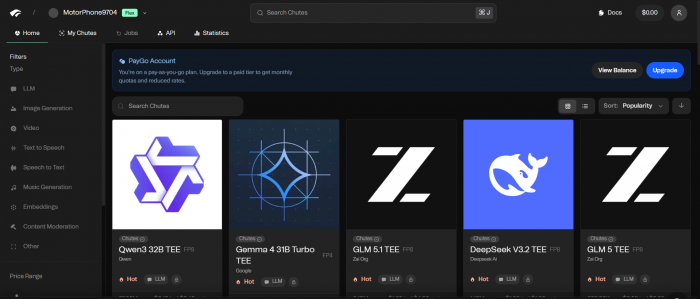
Chutes AI has two practical entry points. The first is model access. The second is deployment.
The easier route is using a hosted model through API. A developer can create an account, generate an API key, select a model, and connect it to an app through an OpenAI-compatible workflow. This is useful for builders who want to test open-source models without hosting them directly.
The more advanced route is deploying a custom Chute. A Chute is essentially a deployable AI workload. Developers can define the application, choose hardware requirements, build the deployment, and expose endpoints. This is where Chutes becomes more than a model API provider.
The platform can support several AI workload categories, including:
● LLM inference for chat, summarization, coding, agents, and internal tools.
● Image and video model backends for apps that need generative media features.
● Speech, music, and audio workloads for multimodal AI applications.
● Embeddings and moderation for search, retrieval, safety, and filtering systems.
● Private or custom deployments for teams that do not want to rely only on shared public inference.
This range makes Chutes AI flexible, but it also means users need to know what they are trying to build before choosing it.
The Platform Feels Technical by Design
Chutes AI does not try hard to hide complexity. That may be a weakness for beginners, but it is also part of the product’s identity.
The experience is built around model catalogs, API references, SDK usage, deployment documentation, pricing tables, hardware choices, and private infrastructure. A developer will understand why those details matter. A casual user may not.
The model catalog is especially important because it is where the real decision starts. Users need to compare models not only by name, but also by cost, speed, task fit, availability, and whether the model is already hot or likely to require startup time.
This creates a very different user experience from a normal AI product. Instead of asking “What can I create today?” Chutes AI makes the user ask “Which model and deployment setup should power this workload?”
That is a more technical question, but it is also the right question for serious AI builders.
Hosted Models vs Custom Chutes
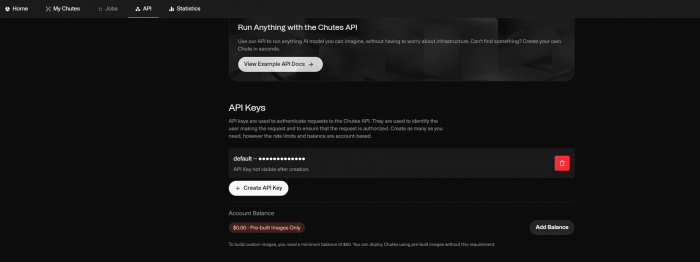
Chutes AI becomes easier to understand when you separate hosted models from custom deployments.
| Option | What It Means | Best For |
| Hosted model API | Use an existing model through Chutes without deploying it yourself | Testing models, powering simple AI features, replacing or comparing model APIs |
| Custom Chute | Deploy your own AI workload using Chutes infrastructure | Custom apps, private models, fine-tunes, specialized AI services |
| Private Chute | Run a dedicated private deployment instead of shared public inference | Sensitive workloads, production traffic, proprietary models, privacy-focused teams |
Hosted models are the lower-friction path. They let developers test open models quickly. Custom Chutes are more powerful but require more setup. Private Chutes are for teams that want more isolation, control, or security.
This layered approach is one of Chutes AI’s strongest qualities. It can serve experimenters and more serious technical teams from the same platform.
Model Quality Is Not a Fixed Chutes Score
The hardest part of reviewing Chutes AI is output quality. With a normal AI app, you can test the tool and rate the output. With Chutes, that approach is incomplete because the platform runs many models.
A response from a Qwen model will not feel the same as a response from a Mistral, Gemma, DeepSeek, GLM, or Kimi model. A smaller model may be cheap and fast but weaker at reasoning. A larger model may follow instructions better but cost more and respond slower. A coding model may perform badly on creative writing. A chat model may fail at structured extraction.
So the right question is not “Is Chutes AI output good?” The right question is “Which model on Chutes is good enough for this exact job?”
For real testing, users should check:
● Instruction following: Does the model follow detailed prompts without drifting?
● Response completeness: Does it finish answers reliably, especially on longer tasks?
● Latency: Does it respond fast enough for a real user-facing app?
● Context handling: Can it manage longer inputs without losing structure?
● Cost per useful result: Does the cheaper model still produce usable output?
● Failure behavior: What happens when the model is overloaded, cold, or inconsistent?
This is where Chutes rewards technical users. It gives options, but it does not make the evaluation decision for you.
Pricing: Cheap on Paper, Careful in Practice
Chutes AI pricing is one of its main selling points, but it needs to be read carefully. The platform uses model-level token pricing for public inference. Input and output prices are listed per 1 million tokens, and the cost changes depending on the selected model.
Chutes also offers monthly plans. The Plus plan is listed at $10 per month and includes a bundled daily quota plus a 6% discount on pay-as-you-go usage beyond the quota. The Pro plan is listed at $20 per month and offers a larger daily quota plus a 10% discount beyond the quota.
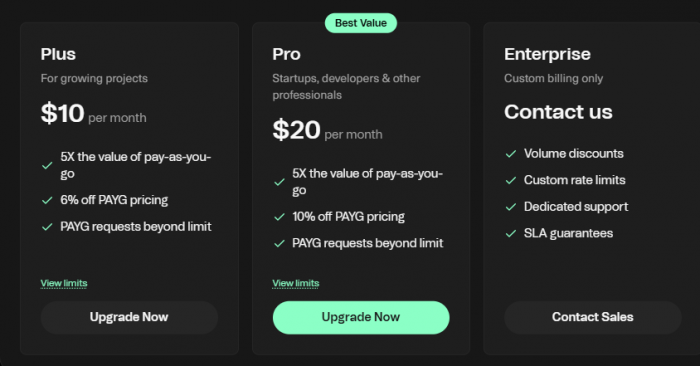
Private Chutes are priced differently. Chutes lists a self-serve private GPU option using an RTX Pro 6000 with 96 GB memory at $1.80 per hour, with a one-time deployment fee of $5.40. Private deployments are billed by runtime, which makes them closer to infrastructure pricing than normal SaaS subscriptions.
| Pricing Layer | How to Think About It |
| Per-token inference | Best for hosted model usage and variable API calls |
| Plus plan | Useful for light users who want quota and a small discount |
| Pro plan | Better for heavier users who expect more usage and want a larger discount |
| Private GPU runtime | Better for dedicated workloads, private models, or production-style deployments |
| Enterprise | Relevant for custom limits, support, security, and volume pricing |
The main advantage is flexibility. Users are not forced into one pricing model. The risk is complexity. Token usage can grow quickly in long-context apps, coding assistants, document analysis systems, and agent workflows.
Cheap inference is valuable only when the output is reliable enough. A model that costs less but needs repeated retries may not be cheaper in real use.
The Privacy Layer Matters More Than It First Appears
Chutes AI has a stronger privacy and security story than many low-cost model access platforms. It promotes Private Chutes and TEE-based confidential compute for workloads that need more protection.
TEE, or Trusted Execution Environment, is designed to protect data while it is being processed. In AI inference, that matters because prompts, outputs, model weights, and runtime memory can contain sensitive information. Chutes’ security positioning is built around the idea that private inference should not require blind trust in the infrastructure provider.
This is a serious differentiator for teams working with private documents, customer data, internal tools, proprietary model weights, or regulated workflows. It gives Chutes a more advanced story than “cheap access to open models.”
Still, this section needs careful framing. TEE is not automatic enterprise compliance. It reduces certain risks, but teams still need to evaluate code verification, data handling, legal terms, logging behavior, access controls, and their own compliance requirements.
For hobby users, TEE may not be the deciding factor. For startups and enterprise teams, it could be one of the main reasons to look at Chutes AI.
The Reliability Question
Chutes AI’s biggest open question is not whether the idea is useful. It is whether the platform is consistent enough for the workload you want to run.
The company presents Chutes as production-ready, with claims around uptime, monitoring, failover, and scalable deployment. That is important, but infrastructure platforms still need real testing under the user’s own traffic pattern.
Public user feedback is mixed. Some users like the low-cost model access and the ability to experiment with open models. Others have raised concerns about latency, incomplete responses, and stability. That does not mean Chutes AI should be dismissed. It means the platform should be benchmarked before becoming the backbone of a real product.
For developers, the minimum test should include normal usage, peak usage, long prompts, repeated requests, model switching, and failure recovery. A model that looks good in a single test may behave differently inside a live application.
Reliability is where Chutes AI moves from interesting to proven. Until a team tests it with real prompts and expected traffic, it should be treated as promising infrastructure rather than guaranteed infrastructure.
Where Chutes AI Wins
Chutes AI is strongest when the user needs flexibility and control.
It gives developers a faster way to test open-source models without standing up their own GPU servers. It also gives teams a path from simple hosted inference to custom deployments. That progression is useful because many AI projects start as experiments but later need more control over performance, cost, or privacy.
The OpenAI-compatible workflow is another practical advantage. Developers who already use OpenAI-style clients may be able to connect Chutes with less friction than starting from scratch.
Private Chutes are also important. Many low-cost model platforms are useful for testing but less convincing for sensitive workloads. Chutes becomes more serious because it offers a dedicated deployment path and a privacy-focused compute story.
The platform also wins on category range. It is not limited to one model type. LLMs, image, video, speech, embeddings, and moderation can all fit into the broader Chutes infrastructure idea.
Where Chutes AI Falls Short
Chutes AI is not built for casual adoption. That is its clearest limitation.
A writer looking for a blog assistant will not enjoy this product. A marketer looking for templates will not get much value from it. A designer expecting a polished visual creation studio will likely prefer tools made specifically for creative workflows.
The second limitation is evaluation burden. Chutes gives access to models, but users must still decide which model is good, fast, reliable, and cost-effective. That is not a small task.
The third limitation is pricing readability. Per-token rates, monthly plans, model-specific costs, private GPU runtime, and deployment fees are all understandable individually, but together they require careful planning.
The fourth limitation is trust maturity. Chutes has useful documentation and technical positioning, but it does not yet have the same broad mainstream review footprint as older or larger infrastructure providers. Public user feedback exists, but it is not as deep or standardized as review data for mature SaaS tools.
Who Should Use Chutes AI
Chutes AI makes sense for users who already think in terms of models, APIs, latency, token cost, and deployment.
It is a good fit for:
● Developers building AI products who want open-model access without managing GPU infrastructure from day one.
● AI startups testing multiple models before committing to a long-term provider or architecture.
● Technical teams looking for cheaper inference than major closed-model APIs.
● Researchers and builders comparing model behavior across tasks.
● Teams that need private deployments for sensitive prompts, proprietary models, or production workloads.
● Python-focused developers who want to deploy AI workloads with more control than a simple model router offers.
The platform becomes especially useful when the user has a real workload to test. Without that, Chutes can feel abstract.
Who Should Skip It
Chutes AI is not the right tool for users who want the AI experience finished for them.
It is not ideal for:
● Bloggers who want a simple writing assistant.
● Marketers who need campaign copy, templates, or social content tools.
● Designers who want a visual image editor or polished creative dashboard.
● Students who want a simple chatbot for research or homework help.
● Small businesses without technical staff.
● Teams that need proven reliability but are not willing to run their own benchmarks.
A simple way to decide is this: if the words API key, token pricing, model endpoint, deployment, and GPU runtime feel irrelevant to your work, Chutes AI is probably not the right product.
Real User Feedback
Public user feedback on Chutes AI is still limited compared with larger AI platforms, but developer communities give a useful picture. Most positive comments focus on its low-cost access to open-source models, API flexibility, and the ability to test different models without setting up GPU infrastructure. reddit
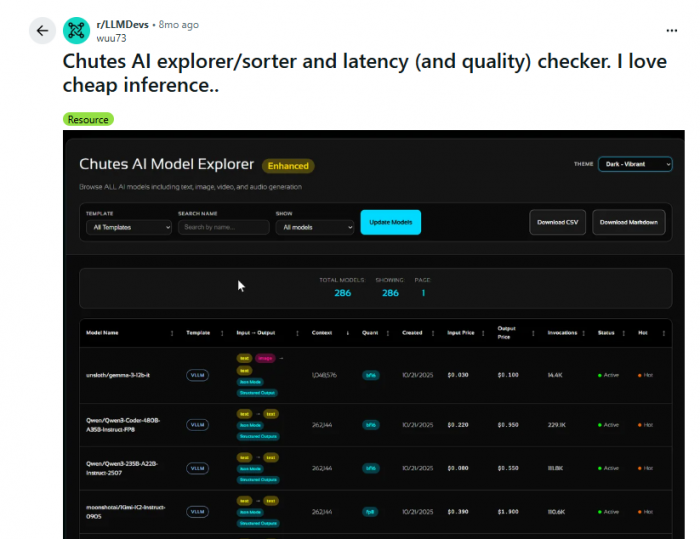
The common concerns are latency, incomplete responses, and stability, especially when users compare it with more established providers. reddit
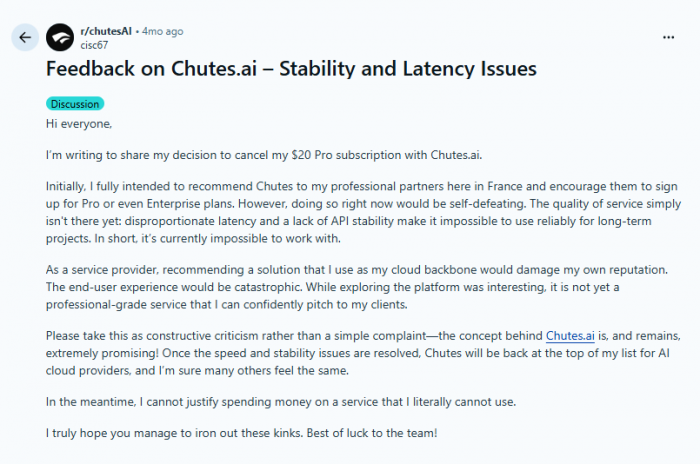
Real user feedback suggests that Chutes AI can be valuable for developers and technical teams, but it should be tested model by model before being used for serious production work.
Chutes AI vs Alternatives
The best alternative to Chutes AI depends on the job.
| Platform | Better Fit When |
| OpenRouter | You mainly want one API to access many models with less deployment complexity. |
| Together AI | You want a more established open-model inference provider for production AI apps. |
| Replicate | You want a simpler model marketplace, especially for creative and experimental models. |
| RunPod | You want direct GPU access, pods, serverless GPU endpoints, and more infrastructure control. |
| Modal | You want serverless Python compute for AI apps, background jobs, and data workflows. |
| Fireworks AI | You want fast open-model inference with production-focused APIs. |
| Baseten | You want a more enterprise-style platform for deploying and serving models. |
| Hugging Face Inference Endpoints | You already use Hugging Face models and want managed deployment inside that ecosystem. |
Chutes AI is most competitive when a user wants both model access and deployment flexibility. If the goal is only model routing, OpenRouter may feel simpler. If the goal is direct GPU rental, RunPod may offer more control. If the goal is enterprise deployment, Baseten may feel more mature. If the goal is open-model inference with strong tooling, Together AI and Fireworks AI are natural comparisons.
My Practical Rating
| Category | Rating | Reason |
| Developer usefulness | 4.2/5 | Strong fit for AI builders, especially those working with open models and APIs. |
| Model flexibility | 4.3/5 | Broad model category support and custom deployment make it more than a simple API provider. |
| Ease of use | 3.1/5 | Clear enough for developers, but not friendly for non-technical users. |
| Pricing potential | 4.0/5 | Can be cost-effective, but users must calculate real usage carefully. |
| Privacy and private deployment | 4.1/5 | Private Chutes and TEE support give it a meaningful security angle. |
| Production confidence | 3.4/5 | Promising, but latency and reliability should be tested before serious use. |
| Casual user value | 2.1/5 | Too technical for people who want a simple AI assistant or creative tool. |
Verdict: Powerful, But Only for the Right User
After going through Chutes AI, I see it more as an infrastructure platform than a normal AI app. Its real value is not in a polished interface, but in giving developers access to open models, cheaper inference options, custom deployments, private workloads, and serverless GPU-backed infrastructure.
Chutes AI is worth testing if you are building an AI product, comparing open-source models, or trying to reduce inference costs. However, it is not the right fit for casual users because it expects knowledge of models, APIs, tokens, latency, and deployment trade-offs. It gives you more control over where and how models run, but you still need to test the models yourself.
My final take is simple: Chutes AI is a strong platform for developers and AI builders, but a poor fit for users looking for a plug-and-play AI tool. Test it if you care about open models, cost control, and private deployment. Skip it if you just want a clean chatbot, writing assistant, or no-code creative app.
Comments